
Quick answer: An independent house is a standalone home on its own plot, with its own entrance and boundary, used by one household. In Lahore, the term mainly separates a full house from a portion, where floors are shared between families. Size, location, construction quality and paperwork matter more than the label itself, so verify each before you buy.
Last updated: October 2026
Many families in Lahore reach the same point after a few years in a rented portion. The rooms feel smaller, the shared gate becomes a daily negotiation, and every month the rent buys nothing permanent. That is usually when the search for an independent house in Lahore begins.
The questions arrive quickly. What exactly counts as “independent”? Is a 5 Marla house in one society the same size as in another? What should you check before paying anything?
This guide answers them in order. It covers what an independent house is, how it compares with other options, which size suits which household, what drives the price, where to look, and how to buy safely.
What Is an Independent House?
The term sounds self-explanatory, but buyers and sellers use it loosely. A listing may call a house “independent” when the ground floor is already rented out, or when it shares a wall with the house next door. Knowing what the word should mean helps you read listings with a sharper eye.
A Simple Definition
An independent house is a complete house built on its own plot and occupied by one household. It has:
- Its own plot, so the land and the building belong to the same owner
- Its own entrance and gate, not shared with another family
- Its own boundary, usually a wall around the plot
- One household using the whole building, from the ground floor to the roof
That last point is what most buyers care about. Nobody else lives above or below you, and nobody else passes through your gate, uses your stairs, or parks in your porch.
A simple test: if the entire property, land and building, can be sold as one unit without affecting another family’s home, it is very likely an independent house.
Independent House vs Portion
This is the comparison that matters most in Lahore, because portions make up a large share of the city’s rental market.
A portion is one floor of a house, usually the upper or lower floor, lived in by a separate household. Two families share the same building and often the main gate, staircase, roof or car porch. Some portions have separate electricity and gas meters; many don’t.
| Independent house | Portion | |
| Who lives there | One household | Two or more households in one building |
| Entrance | Private | Often shared |
| Roof and outdoor space | Yours alone | Shared or divided by floor |
| Utilities | Under one owner’s control | Sometimes shared; separate meters vary |
| What you own (if buying) | The full house and plot | Depends on the arrangement |
| Typical cost | Higher | Lower |
Portions exist for good reasons. They cost less to rent and let owners earn income from a large house. For a family planning to stay long term, though, shared arrangements tend to create friction over parking, water tanks, noise, roof use, and who pays for repairs.
One thing to watch for in listings: a house described as “independent” is sometimes already split into portions, with one floor rented out. That doesn’t make it a bad purchase, but it changes what you are buying. Ask whether any floor is occupied by tenants, and on what terms.
Single Storey vs Double Storey
Height doesn’t decide whether a house is independent. A single storey and a double storey house are both independent, as long as one household uses the whole building.
The choice affects daily life:
- Single storey houses keep everything on one level. They suit elderly parents, anyone with limited mobility, and families who would rather avoid stairs. The trade-off is fewer rooms on the same plot.
- Double storey houses fit more bedrooms on the same land. On 3 or 5 Marla plots, building upward is often the only way to get the room count a family needs.
Double storey houses also suit joint families. Two generations can each have their own floor while still living in one independent home, behind one gate, under one owner.
If you might rent out a floor in future, check early whether the layout allows a separate entrance and separate meters, and what the society’s rules permit.
Independent House vs Townhouse, Apartment and Plot
Few buyers weigh an independent house against nothing. Most compare it with three other options at the same time, each offering something different: a lower entry price, less building work, or more freedom over the design.
| Independent house | Townhouse | Apartment | Plot | |
| What you get | A complete house on its own plot | A house in a row or attached layout | A unit inside a larger building | Land only |
| Shared walls | None with neighbours | Usually one or more | Walls, floors and ceilings | None |
| Construction | Already built | Built by the developer | Already built | You build it |
| Privacy | Highest | Moderate | Lowest | Depends on what you build |
| Outdoor space | Your own lawn, porch or roof | Limited, layout-dependent | Usually a balcony | Whatever you design |
| Typical budget level | Higher | Often lower than a same-size independent house | Varies widely | Lower entry, plus construction cost |
| Maintenance | Entirely yours | Mostly yours | Often shared through management | Yours once built |
A few points the table can’t capture:
A townhouse is the closest alternative. It is a full house for one household, so it avoids the shared-floor problems of a portion. Because it is built in a row, often sharing walls, it uses land more efficiently. If budget matters as much as privacy, it deserves a proper look. Barir Developers offers townhouses through Pine Homes in Union Town, and our article on why families are choosing townhouses in Union Town explores the trade-offs.
An apartment solves different problems. It suits buyers who want less upkeep and don’t need outdoor space. For families with children, the lack of a private yard and limited parking usually tip the balance. Our comparison of townhouses vs apartments in Lahore covers this in more detail.
A plot gives the most freedom and the most work. You choose the layout, but you also take on approvals, contractors, material costs and months of supervision. A low land price can look attractive until construction is added. For buyers living abroad, managing a build from a distance is a serious undertaking.
There is no universally right answer. An independent house makes most sense when privacy, outdoor space and long-term control matter more than the lowest possible entry price. Which raises a fair question: what does that extra cost actually buy you?
Why Lahore Families Choose Independent Houses (and the Trade-Offs)
Mostly, it buys control. You decide how the space is used and when repairs happen, and nobody else’s habits shape your day. That control also brings responsibilities that a portion or apartment would spread across other people, so both sides deserve a fair look.
Privacy, Control and Separate Utilities
Privacy is the reason most buyers give first, and it shows up in small, daily ways:
- No shared gate or staircase. Guests, deliveries and children’s comings and goings concern only your household.
- Your own roof. In Lahore, the roof is used for drying clothes, water tanks, winter afternoons and family gatherings. In a portion, roof access is a frequent source of disagreement.
- Parking on your terms. The porch is yours, with no coordinating over who blocks whom.
Control extends to the house itself. You choose when to repaint, renovate or add a room, within the society’s building rules.If a pipe leaks, you fix it on your schedule instead of negotiating with the family upstairs.
Utilities follow the same logic. When the electricity, gas and water connections serve only your household, the bills reflect only your use. Splitting one meter between families is a common cause of friction, especially when summer electricity bills climb.
Space for Growing and Joint Families
Lahore families often plan housing around more than one generation. Parents may move in later. Children need their own rooms as they grow. A married son may stay in the family home rather than move out.
An independent house absorbs these changes better than most alternatives. A double storey layout can give parents a ground-floor bedroom while the younger family uses the upper floor, all within one boundary. On a larger plot, there may be room to extend later, if the rules allow.
Outdoor space matters here too. A small lawn or courtyard gives children somewhere to play without leaving home, which becomes more valuable as older neighbourhoods grow more crowded.
Some buyers also see an independent house as a long-term asset to pass down or rent out. That is a separate question with its own risks, covered in our article on why an independent house can be a smart investment. This guide stays focused on living in one.
The Downsides to Weigh Honestly
None of these is a reason to avoid an independent house. Each is something to plan for.
| Advantages | Trade-offs |
| Full privacy for one household | Higher purchase price than a portion or same-size townhouse |
| Control over layout, repairs and renovations | All maintenance costs fall on you |
| Separate utilities and bills | Connections and repairs are your responsibility |
| Space for joint or growing families | Larger houses cost more to run, clean and cool |
| Private outdoor space and parking | Outside a gated community, security is largely up to you |
Two of these deserve more attention.
Maintenance adds up. Waterproofing the roof before monsoon, servicing water pumps, fixing seepage and repainting every few years all fall on one household. Treat upkeep as a regular cost, not an occasional surprise.
Security depends on location. In an open neighbourhood, you may need your own guard, cameras or stronger gates. In a gated community, much of this is handled by the society, usually in exchange for maintenance charges. That is one reason many buyers now look for independent houses inside managed societies. Our guide to gated communities in Lahore for families explains what to look for.
If these trade-offs feel manageable, the next decision is practical: how much house do you actually need? In Lahore, that starts with the marla, a unit far less consistent than most buyers expect.
Independent House Sizes in Lahore: 3 Marla to 1 Kanal
Houses in Lahore are described by plot size, in marla or kanal. You will see “5 Marla house” or “1 Kanal bungalow” long before you see a square-foot figure. That makes comparisons look simple, until you try to make one.
Why “Marla” Doesn’t Mean the Same Area Everywhere
A marla is a traditional unit of land, and it isn’t applied consistently. Two values are common in Lahore:
- 225 square feet per marla, used by many housing societies
- 272.25 square feet per marla, the standard revenue measure often found in older areas and land records
The gap of about 47 square feet multiplies with every marla:
| Plot size | At 225 sq ft per marla | At 272.25 sq ft per marla | Difference |
| 3 Marla | 675 sq ft | about 817 sq ft | about 142 sq ft |
| 5 Marla | 1,125 sq ft | about 1,361 sq ft | about 236 sq ft |
| 10 Marla | 2,250 sq ft | about 2,723 sq ft | about 473 sq ft |
| 1 Kanal (20 Marla) | 4,500 sq ft | about 5,445 sq ft | about 945 sq ft |
At 1 Kanal, the difference is roughly the size of an extra 4 Marla plot. Two houses advertised at the same size can sit on noticeably different amounts of land.
There is a second distinction buyers often miss: plot area is not covered area.
- Plot area is the land inside the boundary.
- Covered area is the built floor space across all storeys.
A double storey house on a 5 Marla plot may have more covered area than plot area, because the floors stack. A single storey house on the same plot will have less, because part of the land stays open for the porch, lawn or setbacks.
When comparing houses, ask for both figures in square feet, and which marla value the society uses. That gives you a fair comparison, even across societies that measure differently.
Which Size Fits Your Household?
There is no fixed rule, but household size, budget and future plans usually point to a range. The guide below reflects common patterns; actual room counts depend on layout and number of storeys.
| Plot size | Usually suits | What to expect | Watch out for |
| 3 Marla | Couples, young families, first-time buyers | A compact house, often double storey | Limited parking and outdoor space |
| 5 Marla | Small to mid-sized families | A common family size in many societies, balancing space and cost | Room to grow depends heavily on layout |
| 10 Marla | Larger and joint families | More rooms, a proper lawn, easier parking | Higher price and running costs |
| 1 Kanal | Large joint families, buyers wanting space for guests or staff | Generous space, often with separate living areas | The highest purchase and upkeep costs; resale depends on local demand |
A practical way to decide is to look five to ten years ahead:
- Who will live here? Count children who will grow up and parents who may move in.
- How many cars will you own? Parking is often the first space a small house runs out of.
- Do you need a work-from-home room? For many families, that has become a fourth bedroom in practice.
- What monthly budget can you sustain? A bigger house costs more to buy and more to run.
Many families settle on 5 Marla, then compare layouts rather than plot sizes. A well-planned 5 Marla double storey house can feel larger than a poorly planned 7 Marla one.
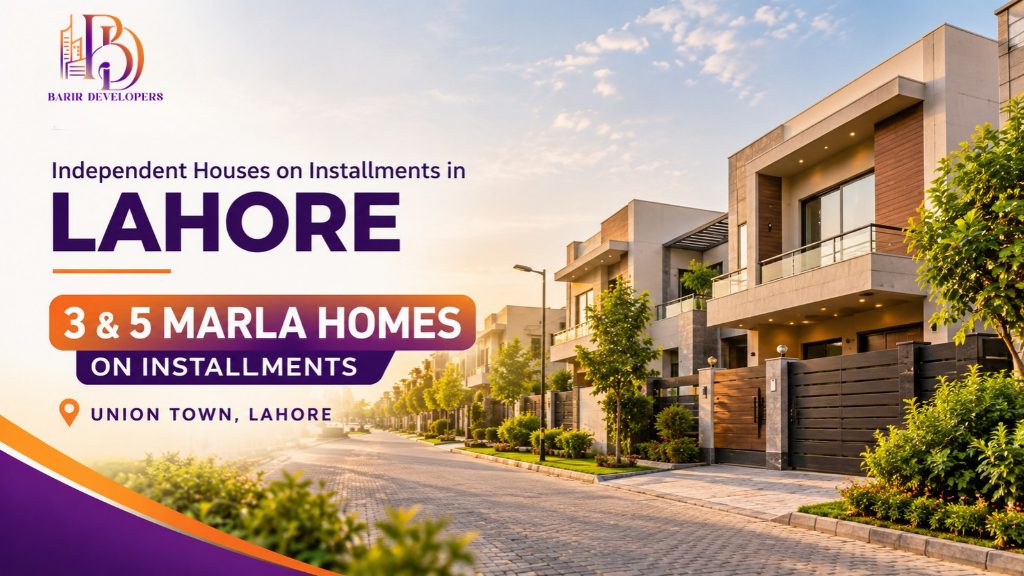
At the smaller end of the range, Barir Developers offers 3 and 5 Marla independent houses in Union Town. Ask for the covered area and floor plan of each before deciding. Whether larger sizes such as 10 Marla or 1 Kanal are available should be confirmed directly.
What Decides the Price of an Independent House in Lahore?
Once you know roughly what size you need, price becomes the obvious next question. Two 5 Marla houses in Lahore can be listed at very different prices, and both can be fair. Plot size tells you little on its own. What matters is everything around it: where the house sits, how it was built, and what condition it is in.
This guide doesn’t quote market prices. Rates change quickly and vary from street to street, so any figure printed here would soon mislead. Instead, here is what pushes a price up or down, so you can judge whether a number makes sense.
The Main Price Factors
Location. Usually the biggest driver by a wide margin. An established neighbourhood near schools, hospitals, markets and main roads generally costs more than a newer area further out. Within one society, a house on the main boulevard or facing a park often costs more than one on an inner street.
The society and its development. Prices tend to reflect how complete and well run a society is: paved roads, working sewerage, reliable water, street lighting, security and maintained parks. A society still developing is usually priced lower, with more uncertainty about when facilities will be finished.
Plot and covered area. Larger plots cost more, but compare covered area in square feet rather than the marla figure alone.
Storeys and layout. A double storey house generally costs more than a single storey one on the same plot, because there is more construction. A smart layout adds value that floor area alone doesn’t show.
Construction quality. Materials, finishing, waterproofing, wiring and plumbing affect both the price and what you will spend later. Two houses that look alike in photos can differ greatly behind the walls.
Age and condition. A new house usually costs more than an older one nearby, but an older house may need repairs that eat into the saving.
Corner and facing. Corner plots and plots facing a park or wide road often carry a premium for light, air and access.
Payment terms. A house sold on installments may be priced differently from a cash sale. Compare the total you will pay, not only the headline figure.
Costs Beyond the Asking Price
The agreed price is rarely the total cost of owning the house. Before committing, find out who pays each of these, and when, and get it in writing.
| Possible extra cost | What to ask |
| Transfer and registration fees | What is charged, and does the buyer or seller pay? |
| Government taxes on purchase | Which taxes apply at current rates? |
| Society charges | Are there transfer fees, development charges or unpaid dues from the seller? |
| Utility connections | Are electricity, gas and water connected, or charged separately? |
| Maintenance or service charges | Is there a monthly or annual charge, and what does it cover? |
| Repairs and upgrades | What will the house need in the first year? |
| Legal review | What will an independent lawyer charge to check the documents? |
Property tax rules have changed several times in recent years. Our overview of the Pakistan Budget 2026-27 and real estate summarises recent changes, but confirm the rates for your specific purchase with a tax adviser or the relevant authority. Build a separate allowance for these costs into your budget from the start, then replace it with actual figures as you receive them.
Where to Look: Choosing an Area in Lahore
Price and size narrow your options, but location decides how the house fits your daily life. A family whose offices and schools are in the city centre will weigh things differently from one that wants more space for the money and doesn’t mind a longer drive.
Rather than ranking societies, it helps to think in three broad types of area, each with its own trade-offs.
Established Neighbourhoods
These are older, fully built areas where infrastructure, markets, schools and hospitals have been in place for years. Model Town, Johar Town and the older phases of DHA Lahore are often mentioned in this category.
What they tend to offer:
- Mature trees, settled communities and complete facilities
- Shorter trips to central parts of the city, depending on where you work
- A long price history, which makes value easier to judge
What to weigh:
- Higher prices for the same plot size
- Many independent houses are older, so condition matters more
- Congestion and narrow streets in some pockets
- Some houses have already been split into portions
Gated Communities
Gated societies are planned developments with controlled entry, internal security and centrally managed services. Bahria Town Lahore is a well-known example, and many newer societies follow a similar model.
What they tend to offer:
- Security managed at the society level
- Planned roads, parks, mosques and commercial areas
- Building rules that keep streets consistent
What to weigh:
- Monthly or annual maintenance charges
- Rules on construction, extensions and renting out floors
- How complete the facilities are today versus what is planned
- The developer’s track record and approval status, verified independently
Developing Corridors Around Pine Avenue and Union Town
On the southern side of the city, newer residential areas have grown along improved road links. Pine Avenue is one of these corridors, and Union Town is one of the communities connected to it.
What they tend to offer:
- More house for the money than established neighbourhoods
- Newer construction, usually with fewer immediate repairs
- Planned layouts in gated or semi-gated settings
What to weigh:
- Some facilities may still be developing, so check what works today
- Travel times depend on which roads are complete and on peak-hour traffic
- Prices in developing areas can move in either direction; future growth isn’t guaranteed
Our guide to living near Pine Avenue covers nearby schools, hospitals and daily routines, and the Union Town Lahore guide explains the community in more detail.
A Quick Way to Compare
| Established | Gated community | Developing corridor | |
| Typical price level | Highest | Mid to high | Lower to mid |
| Age of houses | Often older | Mixed | Mostly new |
| Facilities | Complete | Planned and managed | Partly complete, growing |
| Security | Mostly up to you | Society-managed | Often society-managed |
| Main risk | Condition of older houses | Charges and rules | Pace of development |
Whichever type you lean towards, visit at the times you would actually travel: the morning school run and the evening commute. A route that takes fifteen minutes on a Sunday afternoon can feel very different at 8 a.m. on a weekday.
New Build or Resale: Which Should You Buy?
Location also shapes a quieter decision: whether to buy a house that has just been built or one that has already been lived in. Established neighbourhoods offer mostly resale houses, while developing areas offer mostly new ones. The age of the house changes what you check, what you spend after moving in, and how much you can negotiate.
A new build has just been completed, or is being completed, and is usually sold by a developer or builder to its first owner. A resale house has been lived in before and is sold by its current owner.
| New build | Resale house | |
| Condition | Fresh construction, modern fittings | Depends on age and upkeep |
| Early repair costs | Usually low in the first years | Can be significant: waterproofing, wiring, plumbing |
| Layout | Current design standards | May feel dated; changes cost extra |
| Price | Often higher for the same area | Often lower, with more room to negotiate |
| Location options | Mostly newer societies and developing areas | Across established neighbourhoods |
| What you can inspect | The finished house, or progress if still under construction | The actual house, including how it has aged |
| Paperwork to check | Developer approvals, allotment, possession terms | Title history, previous transfers, unpaid dues |
A new build tends to suit buyers who want to move in without renovating, prefer modern layouts, or are buying from abroad and can’t supervise repairs. The main thing to verify is the developer and the project, not the house’s age.
A resale house tends to suit buyers who want a specific established neighbourhood, have time to inspect carefully, and can budget for repairs. The main risks are hidden structural problems and an unclear ownership history.
One caution: “new” sometimes means “not yet finished.” If the house is still under construction, you are effectively buying off-plan, and the risks shift towards delays and possession timelines. Our guide to off-plan vs ready-to-move property in Lahore explains how those risks differ.
Paying in Full vs Buying on Installments
New or resale, every purchase comes down to how you will pay. Most independent houses in Lahore are bought in one of two ways.
Paying in full keeps the transaction simple, often gives you more room to negotiate, and usually allows ownership to transfer sooner. The trade-off is that you need the entire amount ready.
Buying on installments lets you start with a down payment and clear the balance on a schedule. It is offered mainly by developers on new houses rather than by private sellers. The total you pay may differ from a cash price, and the written terms on possession, late payments and transfer matter a great deal.
Installment plans deserve a guide of their own. Our page on independent houses on installments in Union Town explains how a plan is structured and what to ask, and our wider guide to houses on installments in Lahore compares options across the city.
Independent Houses in Union Town by Barir Developers
If a new build in a developing area fits your plans, here is what Barir Developers currently offers, and what to confirm before going further.
Barir Developers is a Lahore-based developer with its office in Sector E, Bahria Town. Its projects are focused on Union Town, where it offers two types of homes:
- Independent houses in 3 Marla and 5 Marla sizes, available on installments
- Townhouses through Pine Homes, for buyers who want a full house at a more compact size
Having both formats in one community helps if you haven’t yet chosen between them. You can see both on the same visit and compare layouts, space and payment terms directly. The Pine Homes Union Town guide explains the townhouse side in detail.
What’s Confirmed and What to Ask
| Detail | Status |
| 3 and 5 Marla independent houses in Union Town | Published by Barir Developers |
| Installment plans available | Published by Barir Developers |
| Current prices for each size | Ask for the latest figures in writing |
| Larger sizes, such as 10 Marla or 1 Kanal | Confirm availability and project |
| Covered area and floor plan for each size | Ask for both, in square feet |
| Project approval status | Ask for written confirmation and verify independently |
| Construction stage and possession timeline | Ask in writing and compare with published updates |
| Exact project location and access roads | Confirm on a map and during a visit |
Where to See More
- Payment terms: the Payment Plans page lists Barir’s published plans by property type.
- Progress on site: the Construction Updates page shows what Barir publishes about work in progress. Dated photos tell you more than a brochure.
- Availability: property listings change over time, so check before planning around a specific size.
Treat this offer as you would any other: ask questions, compare answers, and see the site yourself. The checklist below applies to Barir’s houses as much as to anyone else’s.
What to Verify Before You Buy
Most problems in property purchases don’t come from bad luck. They come from a check that was skipped because everything looked fine at the time. A clear checklist protects you, and it makes the conversation easier, because you are asking standard questions rather than sounding suspicious.
The checks differ by seller, so they are split below. If you are buying a resale house inside a developer-run society, use both lists.
Buying From a Developer
With a new house, most of the risk sits with the project: whether it is approved, whether it will be finished as promised, and whether you will receive proper ownership papers.
| Check | What to look for |
| Project approval | Written confirmation from the relevant authority, verified independently |
| Developer track record | Completed projects you can visit and residents you can speak to |
| Ownership documents | What you will receive (allotment letter, agreement, transfer papers), in what form, and when |
| Payment plan | Every amount and due date, including any larger lump-sum payments |
| Possession terms | A written timeline, and what happens if it slips |
| Default and cancellation | What happens if you miss a payment or withdraw |
| Construction progress | Dated photos and a site visit that match what you were told |
| Specifications | Materials, fittings and finishes listed in the agreement, not just shown in a model house |
| Receipts | An official receipt for every payment, with date, amount and name |
Our guide on how to verify a real estate developer explains how to confirm approvals on your own.
Buying a Resale House
With a resale house, the two biggest risks are the ownership history and the building’s condition. Both can be checked; both take time.
Ownership and paperwork
| Check | What to look for |
| Title and ownership | The seller’s documents, matched against official land or society records |
| Ownership chain | How the property reached the current owner, with no gaps or disputes |
| Seller’s identity | That the seller is the registered owner, or properly authorised to sell |
| Outstanding dues | Unpaid society charges, utility bills or property taxes |
| Existing tenants | Whether any floor is rented, and on what terms |
| Building approval | Whether the house was built to an approved plan |
| Legal review | A lawyer’s check of all documents before any significant payment |
Physical condition
Visit at least twice, ideally once in daylight and once after rain if the season allows. Look for:
- Seepage and damp: ceiling stains, peeling paint or a musty smell, especially on the top floor and near bathrooms
- Roof waterproofing: when it was last done, and whether the roof drains properly
- Structural cracks: fine plaster cracks are common; wide or diagonal cracks in walls or beams need a professional opinion
- Wiring: the age of the system, the distribution board, and whether it can handle air conditioners
- Plumbing and water pressure: run the taps on every floor and check the tank and pump
- Drainage: whether drains flow freely and how the street copes after rain
If anything looks doubtful, pay a qualified engineer or experienced contractor to inspect it. The fee is small next to the cost of a structural problem found after you move in.
Three Habits for Every Purchase
- Get everything in writing. Verbal promises carry little weight in a dispute.
- Pay through traceable channels. Avoid large cash payments and keep proof of every transaction.
- Don’t let urgency rush you. “Only one left” and “price goes up next week” are sales pressure, not reasons to skip a check.
How to Buy an Independent House in Lahore, Step by Step
With the checks understood, the purchase itself follows a fairly predictable sequence. Knowing it in advance makes it easier to notice a step that is missing or being rushed.
- Set your budget, including extra costs. Work out what you can pay upfront, what you can sustain monthly if buying on installments, and add transfer, tax and repair costs.
- Shortlist by size and area. Narrow your search to two or three areas and one or two plot sizes.
- Visit more than once. See each house at different times of day, and test the route at your usual commute time.
- Request documents and terms. From a developer: payment plan, possession timeline, specifications and approval details. From a private seller: ownership papers and a list of any dues.
- Verify independently. Work through the checklist above. Have a lawyer review the documents, and an engineer inspect a resale house if anything looks doubtful.
- Negotiate and agree terms. Settle the price, schedule, possession date and who pays which costs, and make sure the written agreement matches what was agreed verbally.
- Pay the token or booking amount and sign. Use a traceable channel, collect an official receipt, and read the agreement fully before signing.
- Complete payment and transfer. For a resale house, this usually means paying the balance and completing the transfer through the relevant society office or land-records authority. For a developer purchase, it means clearing the installments and receiving possession and ownership papers as agreed.
- Inspect before moving in. Check that the house matches the agreed specifications, utilities work, and any defects are listed for the seller or developer to fix.
Keep one folder, physical and digital, with every document and receipt from Step 4 onward. You will need it for the transfer, and again if you ever sell.
Buying From Overseas
Many Pakistanis abroad buy homes in Lahore, either to return to or for family living here now. The steps are the same, but a few need extra planning:
- Viewing the house: Ask for a live video walkthrough, not just photos. Better still, send a trusted relative or friend with the inspection checklist.
- Someone to act for you: A representative signing documents or completing the transfer will need proper legal authorisation, usually a power of attorney. Confirm the exact requirements before you start.
- Sending payments: Confirm which channels the seller or developer accepts from abroad, and use formal banking so every payment is documented.
- Receiving documents: Agree how receipts and ownership papers will reach you, and keep scanned copies.
- Choosing what to buy: New builds from established developers are often easier to manage from abroad, since there is less renovation to supervise. Resale houses usually need someone on the ground.
Our guide for overseas Pakistanis buying property in Lahore is written around townhouses, but most of its advice on remote purchases applies to independent houses too.
Frequently Asked Questions
What is an independent house?
An independent house is a complete home on its own plot, with its own entrance and boundary, used by one household. Nobody else lives above or below you or shares your gate. In Lahore, the term mainly separates a full house from a portion, where different families live on different floors of one building.
What is the difference between an independent house and a portion?
A portion is one floor of a house, such as the upper or lower portion, occupied by a separate household. Portions often share a gate, staircase, roof or parking. An independent house gives one household the whole building and plot. Portions cost less but offer less privacy and more room for disputes over shared spaces.
Is an independent house better than a townhouse?
It depends on your priorities. An independent house generally gives more privacy and outdoor space because it shares no walls with neighbours. A townhouse is usually more compact and often more affordable because it uses land efficiently. Families needing room to grow often prefer independent houses; budget-focused buyers often choose townhouses.
What size independent house is best for a family in Lahore?
Small families often find 3 or 5 Marla enough, especially in a double storey layout. Larger or joint families usually look at 10 Marla or 1 Kanal. Because a marla can mean 225 or 272.25 square feet, compare houses by covered area in square feet, and plan for your needs five to ten years ahead.
How big is a 5 Marla house in square feet?
The plot is about 1,125 square feet where a marla is counted as 225 square feet, or about 1,361 square feet at 272.25 square feet per marla. Covered area is a separate figure. A double storey house can have more covered area than its plot size, so ask for both numbers.
How much does an independent house cost in Lahore?
There is no single figure. Price depends mainly on location, plot size, covered area, number of storeys, construction quality, the society’s development, the age of the house, and whether it is a corner plot. Check current listings in your shortlisted areas, and add transfer costs, taxes and repairs to the asking price.
What should I check before buying an independent house?
For a new build, verify the project’s approval, the developer’s track record, the written payment and possession terms, and construction progress. For a resale house, check the ownership history, outstanding dues and the building’s condition, including seepage, cracks, wiring and plumbing. In both cases, have a lawyer review the documents before paying.
Can overseas Pakistanis buy an independent house in Lahore?
Yes. Overseas buyers usually view the house by video call or through a trusted representative, pay through formal banking channels, and appoint someone with proper legal authorisation if they can’t sign in person. Keep every term and receipt in writing, and confirm authorisation requirements before you start.
Next Step: See the Houses in Person
You now know what makes a house truly independent, how to compare sizes in square feet, what drives the price, and what to verify before you pay. What remains is to stand inside a house and test it against your own checklist.
If Union Town is on your shortlist, Barir Developers can show you its 3 and 5 Marla independent houses alongside the Pine Homes townhouses, so you can compare both formats in one visit. Bring this guide, ask your questions, and judge what you see for yourself.
- Schedule a site visit
- Message the sales team on WhatsApp
- Check current availability on the property listings page
- Learn more about Barir Developers