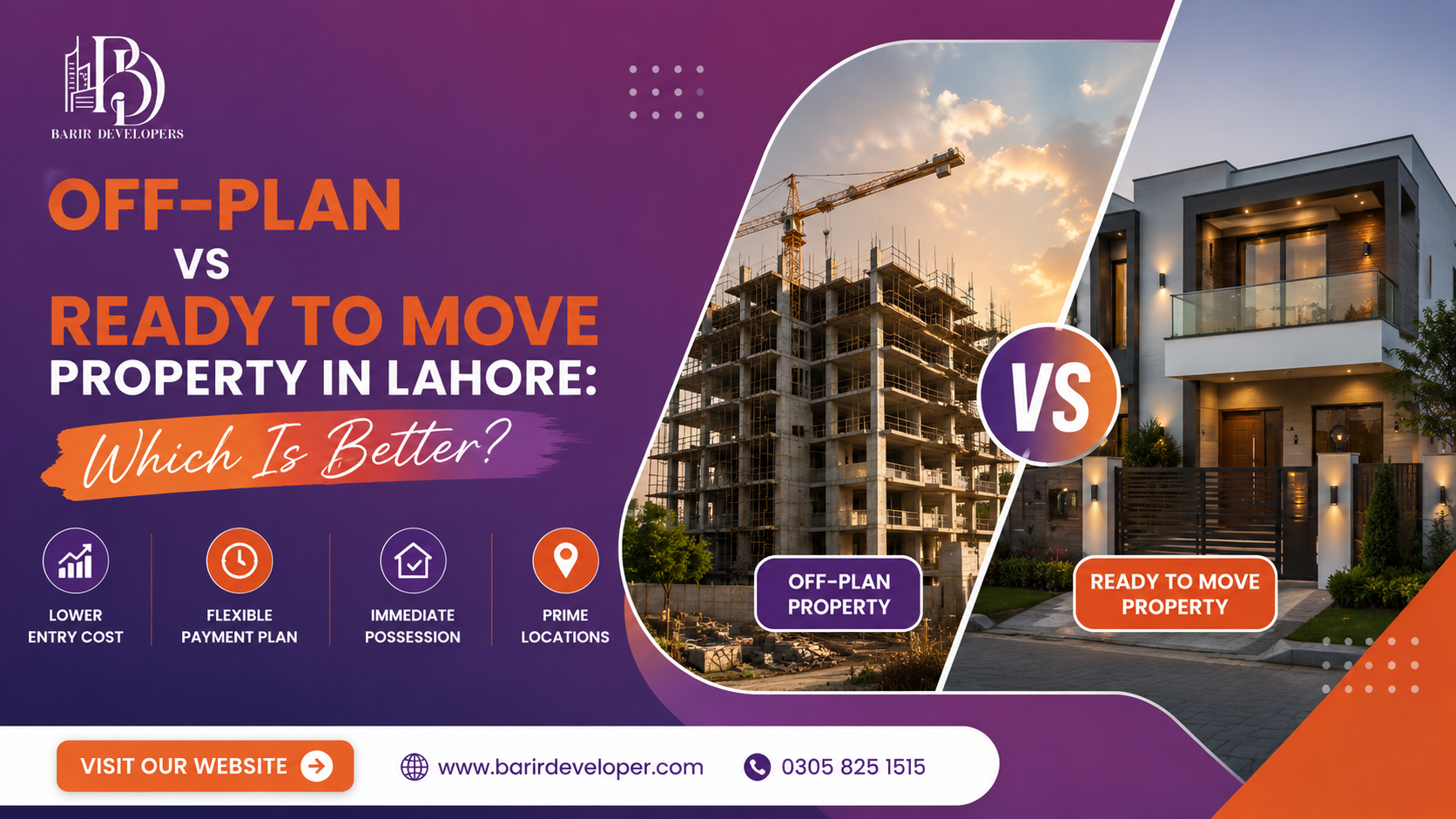

Quick answer: Off-plan property usually costs less and can be paid for in installments, but you wait for possession and carry the risk of delays. Ready to move property costs more, but you can inspect it and move in or rent it out straight away. The right choice depends on your timeline, your budget and how much uncertainty you can manage.
You’ve found a project you like, the sales team is offering an easy installment plan, and the brochure looks great. But a finished house in an established society feels safer, even if it costs more upfront. Which way should you go?
Choosing between off-plan vs ready to move property in Lahore is one of the most common dilemmas buyers face, and it is rarely as simple as either sales pitch suggests. This guide explains what each option really involves, where the money and the risks sit, and how to decide based on your own situation.
What Off-Plan and Ready to Move Property Mean in Lahore
Both terms are used loosely in sales conversations, and that is where a lot of confusion starts. A unit described as “almost ready” may still be months from possession, and an “off-plan” project may already be well into construction. Before comparing price or risk, be clear about what you would actually be buying.
Off-plan property is a house, townhouse or apartment booked before construction is complete, sometimes before it has started. You commit based on plans, a layout, a payment schedule and the developer’s promise to deliver.
Ready to move property is a completed unit you can inspect, buy and occupy, or rent out, without waiting for construction.
The difference isn’t only about time. It is about what you can verify before you pay. With a ready house, you see what you’re getting. With an off-plan home, you rely on documents, approvals and the developer’s track record.
How an Off-Plan Booking Works, Step by Step
Details vary between developers, but most off-plan purchases in Lahore follow a similar path:
- Token money. A small advance to hold a specific unit. Ask whether it is refundable, and get a written receipt.
- Booking form and down payment. You sign the booking form and pay the initial amount. This form usually sets out the price, the payment schedule and the terms for delays, cancellation and transfer, so read it before signing.
- Allotment letter. The developer formally allots a specific unit to you.
- Installments. You pay the balance monthly, quarterly or in line with construction stages, depending on the plan.
- Possession. Once construction is complete and your dues are cleared, the unit is handed over, normally with a possession letter.
- Transfer of ownership. The final legal transfer is completed under the society’s and developer’s procedures.
Step four is why many buyers choose off-plan, and spreading the cost is a big part of why installment properties in Lahore have become so popular. But steps two and three are where careful buyers protect themselves, because that is where the terms are put in writing.
What Counts as “Ready to Move”: Ready Possession, Near-Possession and Grey Structure
Not every property marketed as “ready” is ready to live in. In Lahore you’ll usually come across three stages:
| Stage | What it means | Can you move in? |
| Ready possession | Construction and finishing are complete, and the unit can be handed over | Yes, once transfer and utility connections are done |
| Near-possession | The structure is largely complete and finishing is underway | Not yet |
| Grey structure | Walls, roof and structure are built, but flooring, fixtures, paint and fittings are not | No. Finishing work and extra cost remain |
A grey-structure house can suit buyers who want to choose their own finishes, but the finishing cost has to be in the budget. Near-possession units sit between the two options: they are often priced below fully ready homes, and much of the construction risk has already passed.
A useful rule: when a seller says “ready,” ask whether the unit can be handed over today, with finishing complete and utilities connected.
Off-Plan vs Ready to Move Property in Lahore: Side-by-Side Comparison
With the definitions clear, the trade-offs become easier to weigh.
| Factor | Off-Plan Property | Ready to Move Property |
| Entry price | Usually lower than a comparable finished unit | Usually higher, as construction risk is already removed |
| Payment structure | Booking amount plus installments during construction | Larger upfront payment or a bank loan |
| Construction risk | Buyer carries the risk of delays and quality changes | None; the unit already exists |
| Time to possession | Months or years, depending on the project | Immediate, once transfer is complete |
| Inspection before buying | Limited to plans, layouts, a model unit or the site | Full inspection of the actual unit |
| Appreciation potential | Can be higher if the project delivers as promised | Usually steadier; the price already reflects completion |
| Rental income | None until possession | Possible from the first month |
| Financing | Mainly developer installment plans | Easier to finance through a bank |
| Resale and liquidity | Depends on transfer rules and demand for files | Sold like any completed property, subject to the market |
| Documents at purchase | Booking form, allotment letter, payment schedule | Title documents, transfer papers, utility records |
How to Read This Table
No column wins on every row. Off-plan gives you a lower price and time to pay in exchange for waiting and risk. Ready property gives you certainty and immediate use in exchange for a higher upfront cost.
The more useful questions are personal ones:
- How soon do you need to live in the property or earn rent from it?
- How much can you pay upfront?
- How much would a delay of a year or more affect you?
- Can you verify a project’s approvals, documents and developer record properly?
Keep these in mind as you read on. Off-plan comes first, because that is where most of the trade-offs sit.
Pros and Cons of Off-Plan Property
Off-plan buying is popular for good reasons, and its risks are just as real. A fair decision needs both sides.
Why Buyers Choose Off-Plan
A lower entry price. Early bookings are often priced below what a finished unit in the same location would cost. The discount is the reward for waiting and taking on risk. Its size varies widely by project.
Payments spread over time. For many families, this matters more than the price itself. Paying a booking amount and then installments can make ownership possible years earlier than saving for a ready house.
Price lock-in. Your price is fixed at booking, as set out in your booking form. If prices rise during construction, you still pay the agreed amount. Check for any clauses that allow later price revisions.
Potential capital growth. If the project is delivered as promised and the area develops, the finished unit may be worth more than you paid. This depends on delivery, location and the wider market, and it is not guaranteed.
A brand-new home. You receive a newly built unit, often with a modern layout and, depending on the project, some choice of finishes.
The Real Risks of Buying Off-Plan
Construction delays. This is the most common complaint about off-plan buying in Pakistan. Funding gaps, approval issues, rising material costs and poor management can all push possession back. Every month of delay means more rent paid elsewhere or income not earned.
Quality that doesn’t match the promise. You buy based on renderings and specifications. If the finished unit uses cheaper materials or differs from the plan, your options may be limited unless the agreement spells out specifications clearly.
Approval and legal problems. Some projects are marketed before they have the required approvals. That can later affect possession, transfer and utility connections.
Developer reliability. Your money depends on the developer finishing the job. No completed projects, unclear land ownership or a history of delays are red flags, however attractive the payment plan.
Unfinished amenities. Parks, gates, mosques, commercial areas and roads shown on the master plan may arrive late or not at all. Ask which are built and which exist only on paper.
Limited exit options. Selling before possession usually depends on the developer’s transfer rules and on demand for the file, so it is not always quick.
None of these risks rules off-plan out. They mean the buyer has to do checks that a ready property makes unnecessary. Those checks are covered later in this guide.
Benefits and Drawbacks of Ready to Move Houses in Lahore
Ready property is the opposite trade: you pay more, and most of the uncertainty disappears. For many buyers that is a sensible exchange, but it is not risk-free.
What You Gain With a Ready Property
- You see exactly what you’re buying. Walk through the house, check the finishing, open the taps and judge the neighbourhood before paying.
- Immediate possession. For a family paying rent, relocating for work or needing space soon, this can outweigh everything else.
- Rental income from the start. An investor can find a tenant straight away.
- No construction risk. Delays and design changes no longer affect you.
- Easier bank financing. Banks generally prefer lending against a completed home they can value. Eligibility and terms vary by bank.
- An established neighbourhood. In developed societies, roads, markets, schools and mosques are already in place.
Why “Ready” Doesn’t Mean Risk-Free
- A higher price, paid sooner. Most of the payment is due upfront or through a loan, which can put ready homes out of reach for buyers who depend on installments.
- Less room for appreciation. Much of the value gained during construction has already gone to the developer or the previous owner.
- Hidden structural or utility problems. Fresh paint can hide seepage, cracks or poor wiring that only appear months later.
- Title and documentation issues. Resale homes in particular can come with incomplete transfers, unpaid dues, disputed ownership or unapproved additions.
- Wear and older layouts. Repairs or renovation can add to the real cost.
A ready property removes construction risk but replaces it with other checks: ownership, legal standing and physical condition. Before those, though, the money deserves a closer look, because the price gap between the two options is not quite what it first seems.
The Price Gap and the Real Cost of Waiting
Comparing the price of an off-plan unit with the price of a ready house only shows part of the picture. What matters is the total cost of each option by the time you are living in the home or earning rent from it.
Why Off-Plan Property Costs Less
- You are paying for time and risk. The discount compensates you for waiting and for the possibility of delay.
- Early bookings help fund construction. Developers price early units to attract buyers whose payments support the building work.
- The unit doesn’t exist yet. A finished home can be inspected, rented and financed, so it commands more.
The gap depends on the project, location, developer reputation and construction stage, and it is usually widest at launch.
One warning sign: if a project is priced far below similar launches nearby, ask why. An unusually low price can reflect a weak developer record or unresolved approvals rather than a genuine bargain.
A Simple Example: Discount vs Rent Paid During Construction
You can test the real cost of waiting with your own figures:
| Item | Off-Plan | Ready to Move |
| Purchase price | A | B |
| Rent paid until possession | Monthly rent × months to possession | None |
| Rental income missed (investors) | Lost until possession | Earned from the start |
| Finishing or repair costs | Usually low | Depends on condition |
| Cost of a delay | Monthly rent × months of delay | None |
- Work out your apparent saving: B − A.
- Subtract the rent you’ll pay until possession, or, if you’re an investor, the rent a ready unit would have earned.
- Repeat the calculation with a realistic delay of, say, 12 months.
If the saving disappears in step three, the off-plan deal only works if the project is delivered on time.
For a family already paying high rent, a long wait can eat into the saving quickly. For someone living rent-free with family, or an investor focused on long-term value, the saving may hold up well even with some delay. That is why possession timelines and delay clauses deserve as much attention as the price.
Which Is Better for Investment?
Investors are asking a different question from homebuyers: which option makes their money work harder? The answer depends on whether you want growth, income or flexibility.
| Investment goal | Off-Plan | Ready to Move |
| Capital growth | Stronger potential if the project delivers | Steadier, market-driven growth |
| Rental income | None until possession | Available straight away |
| Liquidity | Depends on transfer rules and demand for files | Generally easier, subject to the market |
| Risk level | Higher | Lower |
Capital Appreciation
Buying at an early price gives off-plan property greater growth potential. As roads are built and the community takes shape, completed units are often valued above the launch price. That potential depends on timely completion, continued development of the area and a stable Lahore property market. A stalled project can erase it.
Ready property carries less of that risk, but growth tends to be slower because the jump from construction to completion has already happened.
Rental Income and Rental Yield
For monthly income, ready property has a clear head start. A simple way to compare options:
Rental yield = (Annual rent ÷ Purchase price) × 100
- Off-plan yield starts later. You lose every month of rent during construction.
- Off-plan yield may start from a lower price. The same rent can mean a higher yield once the unit is let, provided possession isn’t seriously delayed.
Demand also depends on location, property type and size.
Resale Value and Property Transfer
Selling an off-plan unit before possession usually means transferring the file, which typically involves the developer’s approval or NOC, clearing dues to date, a transfer fee depending on the developer’s policy, and finding a buyer willing to take over the remaining installments. If demand weakens or construction slows, that can be difficult.
A ready property follows the normal transfer process for completed homes, which is usually more straightforward, although timing and price still depend on the market.
Which Option Fits Your Situation?
Returns are only one way to look at the decision. For most people, the right choice depends on who they are, where they live and what they need the property for.
First-Time Homebuyers
First-time buyers often lack a large lump sum, which makes off-plan installments the most realistic route to ownership. They are also usually the least familiar with approvals and delay clauses, and a late project hurts most when you are paying rent and installments at the same time.
Verdict: Off-plan can work if you can afford rent and installments together for longer than planned, and you verify the project carefully. If your budget has no margin for delay, look at near-possession units or an affordable ready home.
Overseas Pakistanis
Many overseas buyers aren’t planning to move in straight away, and installments can be easier to manage from abroad than one large transfer. The challenge is verification, since you can’t easily visit the site or handle paperwork in person. Favour developers who share regular, dated construction updates and answer document questions clearly.
Verdict: Off-plan often suits overseas Pakistanis, provided the project can be verified remotely. If you want rental income from day one, a ready property managed by a trusted local contact may fit better. Our guide for overseas Pakistanis buying a townhouse in Lahore covers this in more detail.
Investors
Verdict: Choose off-plan for long-term capital growth, if you can keep your money in the project until possession and accept the delay risk. Choose ready property for immediate rental income, lower risk or easier liquidity. Some investors hold one of each to balance the two.
Families Who Need to Move In Now
If your lease is ending, your family is growing or you’re relocating to Lahore, time decides. A home that will be ready in a few years doesn’t solve a housing need you have today, however good the price.
Verdict: Ready to move property is the clear choice. A near-possession unit can work only if the handover date is confirmed in writing.
Paying for It: Installments, Down Payment and Bank Financing
How you pay often decides which option is realistic before anything else does.
Off-Plan Property on Installments in Lahore
Off-plan plans usually combine a booking or down payment, regular monthly or quarterly installments, and sometimes larger milestone (balloon) payments or a final amount at possession. Structures differ, so don’t judge a plan by its monthly figure alone. Check:
- The total price across all payments
- Any balloon payments that could strain your budget later
- Late-payment penalties and what happens if you miss installments
- Whether installments are linked to construction progress or only to dates
- Extra charges at possession, such as development, utility or documentation fees
Our guide to buying a townhouse on installments in Lahore covers these checks in depth, and the Barir Developers payment plans page shows how a structured plan is laid out.
Can You Buy a Ready to Move House on Installments?
Sometimes, but it is less common and less flexible. Where developers offer installments on finished units, they usually ask for a larger down payment and a shorter repayment period. Private resale sellers generally expect full payment soon after the token. For more options, see houses on installments in Lahore.
When a Bank Home Loan Makes Sense
Bank financing generally works better for ready property, which can be valued, inspected and legally verified. Financing off-plan units is usually harder, though some banks may consider projects at an advanced construction stage. A loan may suit you if you have stable, documented income, can manage the bank’s down payment and want longer repayment terms than a developer plan offers.
A bank also reviews a ready property’s documents. With off-plan, that checking falls mostly on you.
How to Check an Off-Plan Project Before You Book
With an off-plan purchase, your protection comes almost entirely from the checks you make before paying token money.
Verify LDA Approval and NOC
- Ask for the approval details in writing, including the approving authority and reference number.
- Check the official records yourself. The Lahore Development Authority publishes information on approved and unapproved housing schemes. Match the project name, location and developer.
- Confirm the right authority. Depending on location, another authority may have jurisdiction instead of LDA.
- Make sure the approval covers what you’re buying. A society may be approved while a specific phase or building type is still pending.
Missing or mismatched approval details are a serious warning sign.
Look at the Developer’s Delivery Record
A payment plan is easy to advertise. A history of finished projects is not. Find out which projects the developer has completed and handed over, whether they were delivered roughly on time, who owns the land, and how clearly the developer answers questions about documents. Visiting a completed project and talking to residents often tells you more than a brochure. Our guide on how to verify a real estate developer in Pakistan gives a full checklist.
Read the Booking Form, Allotment Letter and Delay Clauses
| Clause | What to check |
| Possession date | A specific date or period, or only vague wording? |
| Delay terms | Grace period, compensation or penalty if possession is late? |
| Cancellation and refund | How much is refunded, and when, if either side cancels? |
| Price revision | Can the price rise, or charges be added later? |
| Specifications | Are materials, finishes and unit size clearly described? |
| Transfer rules | Can you sell before possession, and on what terms? |
Make sure the allotment letter names your unit, keep every receipt and letter, and get advice from a property lawyer if any clause is unclear.
Visit the Site and Track Construction Progress
- Visit more than once, a few weeks apart, to see whether work is moving
- Check roads, boundary walls and utilities, not just show units
- Ask for regular, dated progress photos or videos
- Compare progress with the payment schedule; if installments are moving faster than construction, ask why
Barir Developers publishes construction updates for Pine Homes so buyers, including those abroad, can follow the work between visits.
What to Check Before Buying a Ready Property
With a finished home, the risks shift to the paperwork and to what a fresh coat of paint can hide.
Title, Ownership and Transfer
- Match the seller’s identity with the title documents and the society’s records
- Confirm that every earlier transfer was completed properly
- Get confirmation that maintenance, utility and development dues are cleared
- Obtain the society’s NOC for sale or transfer, where it applies
- Check for mortgages, court cases or family claims
- Confirm the building matches the approved plan, with no unapproved floors or extensions
For resale homes, a property lawyer’s fee is small compared with the cost of a title dispute.
Physical and Utility Inspection
| Area | What to check |
| Structure | Cracks in walls, ceilings or beams; uneven floors |
| Damp and seepage | Stains or peeling paint, especially in bathrooms and ceilings |
| Plumbing | Water pressure, leaks, drainage, water tank condition |
| Electrical | Wiring, distribution board, earthing, switches and sockets |
| Utilities | Electricity, gas and water connections installed and in the right name |
| Finishing | Doors, windows, kitchen and bathroom fittings |
If you can, visit at different times of day. Water pressure, light, noise and parking often change between morning and evening.
Taxes and Transfer Costs on Both Options
Both options involve costs beyond the price, including FBR withholding tax on purchase (generally higher for buyers not on the Active Taxpayer List), stamp duty and registration charges, capital value tax where applicable, society or developer transfer fees, and legal costs. Sellers, including investors who resell, may face withholding and capital gains tax.
Rates change from budget to budget. For recent changes, see our breakdown of real estate tax reforms in Pakistan 2026.
Common Mistakes Buyers Make
Most expensive property mistakes come from a skipped check or a promise that was never written down:
- Choosing off-plan on price alone, without checking the developer and approvals first.
- Paying token money before reading the booking form, when it is hardest to negotiate or walk away.
- Ignoring the cost of waiting, and comparing purchase prices without counting rent paid during construction.
- Assuming a ready house has no risks, and skipping the title and condition checks.
- Judging a payment plan by its monthly figure, and missing balloon payments or possession charges.
- Relying on verbal promises about possession dates, amenities or specifications that aren’t in the agreement.
- Forgetting taxes and transfer costs when setting the budget.
Should I Buy Off-Plan or Ready Property? A Quick Decision Checklist
Tick the statements that are true for you. The column with more ticks is usually the better fit.
| Choose off-plan if… | Choose ready to move if… |
| You don’t need to move in or earn rent for a few years | You need a home now or want rental income straight away |
| You need installments rather than a large upfront payment | You can arrange a large down payment or a bank loan |
| A delay wouldn’t cause serious financial strain | A delay would cause real problems for your family or budget |
| Your main goal is long-term capital growth | Your main goal is income, certainty or lower risk |
| You’ve verified the approvals and the developer’s record | You’d rather inspect the actual property before paying |
| You can follow construction in person or through regular updates | You can’t monitor a project over several years |
| You can keep your money in one project until possession | You may need to sell or access your money at short notice |
If your answers are split, consider a near-possession unit, an off-plan project already well into construction, or a ready home with an installment option.
Whichever way the checklist points, verify before you pay.
Where Pine Homes Fits In
Transparency note: Barir Developers sells off-plan homes. This guide is meant to help you weigh both options fairly.
Pine Homes is a townhouse project by Barir Developers on Pine Avenue in Union Town, Lahore, offering 4 Marla townhouses and 5 Marla townhouses. The project is currently under construction, which places it on the off-plan side of this comparison.
Everything in this guide applies to Pine Homes too. Before booking, we encourage buyers to:
- Ask for the project’s approval details and check them independently
- Review the payment plans and the total cost
- Read the booking form, including the possession timeline and delay terms
- Follow the construction updates and visit the site in person if you can
If you need a home immediately, Pine Homes may not be the right fit yet. If you’re planning ahead, want to pay in installments and prefer to see progress for yourself, it may be worth a look.
Frequently Asked Questions
What is off-plan property? (Off-plan property kya hoti hai?)
Off-plan property is a home you book before construction is complete, and sometimes before it starts. You usually pay a booking amount and then installments, and receive possession when the developer finishes the project. It is typically priced below a completed home because the buyer waits for delivery and carries the risk of delay.
Is it safe to buy off-plan property in Lahore?
It can be, if you verify the project before paying. Check its approval with the relevant authority, review the developer’s record of completed projects, and read the possession, delay and refund clauses in the booking form. Visiting the site over time adds further protection. Avoid projects that can’t show clear approvals or real progress.
Which is better: off-plan or ready to move property in Lahore?
Neither is better for everyone. Off-plan suits buyers who can wait, want a lower entry price and need installments. Ready to move property suits buyers who need a home now, want immediate rental income or prefer to avoid construction risk. Your timeline, budget and tolerance for delay should decide.
How much cheaper is off-plan property than ready property?
Off-plan units are usually priced below comparable ready homes because the buyer takes on the wait and the delay risk. The gap varies by project, location, developer and construction stage, and is usually widest at launch. Compare total cost, including rent paid while waiting, rather than the purchase price alone.
What happens if the developer delays possession?
It depends on your agreement. Some booking forms include a possession date, grace period, compensation for delay or refund terms. Others use vague wording that offers little protection. Read these clauses before paying token money, keep every receipt and letter, and seek legal advice if a delay leads to a dispute.
Can I buy a ready to move house on installments in Lahore?
Sometimes. Some developers offer installments on completed units, usually with a larger down payment and a shorter period than off-plan plans. Private resale sellers generally expect full payment. A bank home loan is the other main option for ready property, subject to the bank’s eligibility rules.
Is off-plan or ready property better for overseas Pakistanis?
Off-plan often suits overseas Pakistanis buying for the future, because installments are easier to manage from abroad. The key is verifying the project remotely through approval documents and regular, dated construction updates. Overseas buyers who want rental income straight away may be better served by a ready property with a trusted local manager.
Conclusion
Choosing between off-plan vs ready to move property in Lahore is a trade between price and certainty. Off-plan offers a lower entry price, time to pay and growth potential, in exchange for waiting and accepting the risk of delay. Ready property costs more, but you can inspect it and use it straight away.
Neither is safe by default. A well-verified off-plan project can be a sound decision, and a ready home bought without checking the paperwork can become an expensive mistake. Decide on your timeline, budget and tolerance for uncertainty, then verify everything before you pay.
If you’re considering an off-plan townhouse and want to judge the progress for yourself, schedule a site visit to Pine Homes in Union Town, ask your questions in person and review the documents before you decide.