By Usama Saleem, SEO Expert, Barir Developers · Last updated: 31-10-2026
Buying property in Lahore usually goes wrong in one of three places. Buyers pay token money before checking the papers. They budget for the price and forget the taxes. Or they think the deal is finished at registry, when the government record still shows the old owner.
This guide walks you through the full property buying process in Lahore, from choosing the right property to holding the keys. You’ll learn how to check LDA approval before paying anything, how to confirm ownership through the fard, what your sale agreement should include, how registry and intiqal work, and which documents you need at each stage.
Every step tells you what to do, what to check and what to avoid. Where rules or rates change often, we point you to where you can confirm the current figure instead of guessing.
The 10 Steps at a Glance
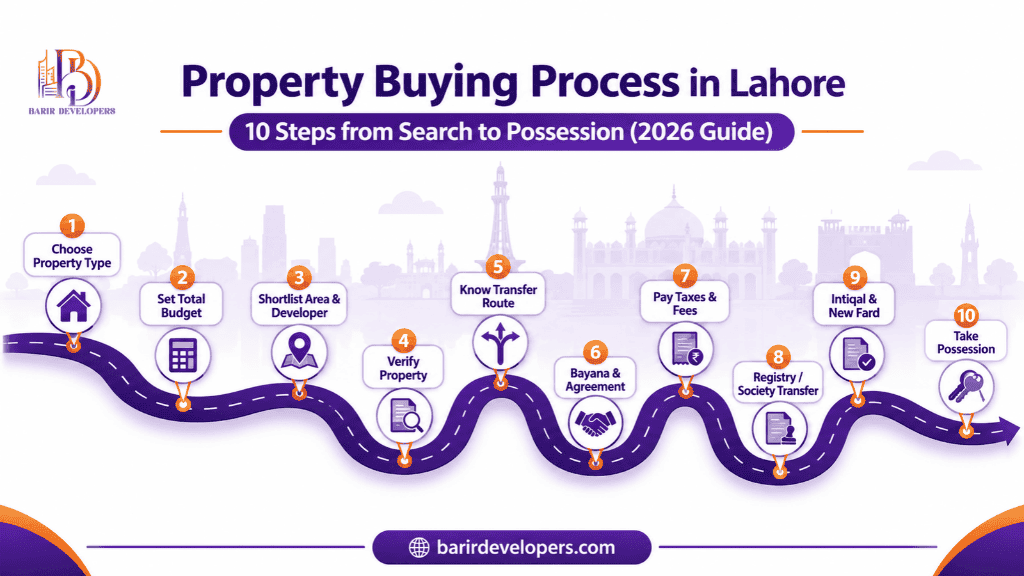
The property buying process in Lahore has 10 steps: choose the property type, set your total budget, shortlist the area and developer, verify the property, confirm your transfer route, pay bayana and sign the agreement, pay taxes and fees, complete the registry or society transfer, get intiqal done, and take possession.
| Step | What you do | What it protects you from |
| 1. Choose the property type | Decide between a plot, house, townhouse or apartment, and between ready-to-move and off-plan | Buying something that doesn’t fit your family, budget or timeline |
| 2. Work out your total budget | Add taxes, fees and other charges to the price | Running short of money at transfer |
| 3. Shortlist the area, society and developer | Compare locations and check the developer’s track record | Getting stuck in a stalled or poorly managed project |
| 4. Verify the property | Check LDA approval, NOC, ownership and any disputes or unpaid dues | Fraud, illegal schemes and double-sold property |
| 5. Know your transfer route | Confirm whether it’s a registered property or a society/developer property | Following the wrong process and ending up with incomplete ownership |
| 6. Pay bayana and sign the agreement | Pay token money against a written sale agreement | The seller backing out or changing terms |
| 7. Pay taxes and transfer fees | Pay the buyer’s taxes and charges through official challans | Transfer delays and penalties |
| 8. Complete registry or society transfer | Register the sale deed, or get the transfer letter from the society | Ownership that exists only on paper between buyer and seller |
| 9. Get intiqal done | Update the government land record and collect a new fard in your name | The old owner still appearing as the legal owner |
| 10. Take possession | Inspect the property, take the keys and move the utilities into your name | Hidden defects and unpaid bills that become yours |
Two things are worth knowing before you start.
The order matters. Most problems start when buyers jump from step 3 straight to step 6, paying bayana on trust and checking the papers later. Verification should always come before money.
Steps 8 and 9 depend on the property. A registered house or plot with a revenue record goes through registry and then intiqal. A property in a private society or developer project usually transfers through the society’s own office, with an allotment or transfer letter. Step 5 helps you work out which route applies.
Buying new from a developer on installments works a little differently. Booking and allotment come first, and possession comes later. The Special Cases section covers this, using a real project as the example.
How Long Does the Whole Process Take?
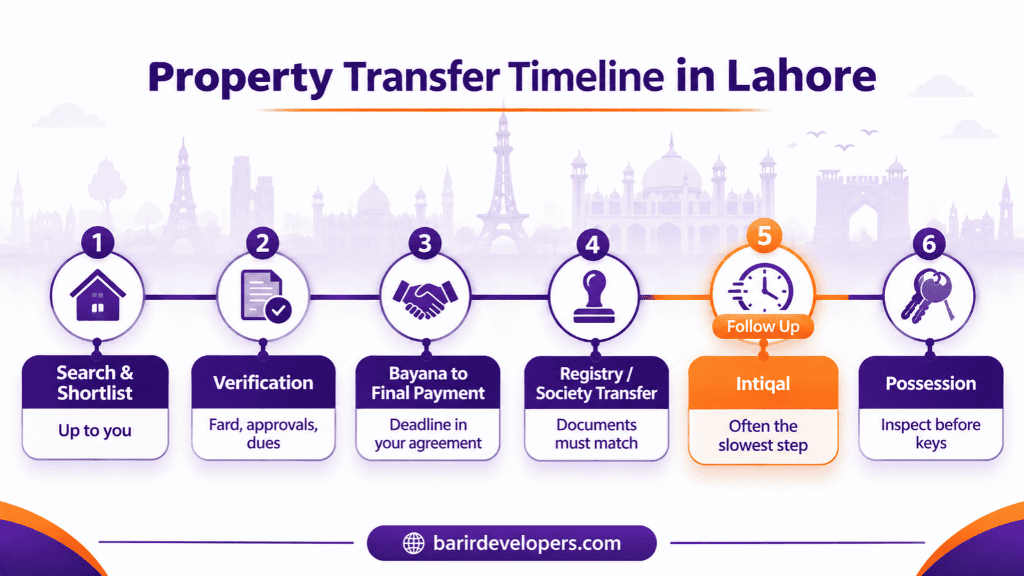
The timeline depends mainly on how clean the documents are and which transfer route applies. A straightforward resale with complete papers moves much faster than a deal held up by a missing document, an inheritance issue or uncleared society dues.
| Stage | What affects the time |
| Search and shortlisting (steps 1–3) | Entirely up to you |
| Verification (step 4) | How quickly you can get the fard, society records and approval details |
| Bayana to final payment (steps 6–7) | The deadline written in your sale agreement |
| Registry or society transfer (step 8) | Appointment availability and whether every document matches |
| Intiqal (step 9) | Often the slowest stage, and usually needs follow-up |
| Possession (step 10) | Immediate for ready property. For off-plan, it depends on construction |
Typical timeline for a registered property transfer
Typical society transfer timeline
You can save weeks by doing four things:
- Collect documents before paying bayana. A late CNIC copy, NDC or tax record causes many of the delays.
- Make sure names match exactly. A small spelling difference between a CNIC and the fard can hold up registry.
- Put deadlines in writing in your sale agreement.
- Follow up on intiqal yourself. It rarely moves on its own.
Step 1: Choose the Right Property Type
Most buyers start by scrolling through listings. A better starting point is one simple question: what is this property for?
A family planning to move in within a year needs something very different from an investor holding for five years. Settle these three things before you look at a single ad:
- Will you live in it, rent it out or hold it for resale?
- When do you need it? Now, in a year or two, or there’s no rush?
- How will you pay? Full payment, installments or bank financing?
Plot, House, Townhouse or Apartment?
| Property type | Best suited for | What to keep in mind |
| Plot | Long-term holding, or buyers who want to build their own design | Construction is a separate cost and takes time and supervision. The approval and possession status of the exact plot matter a lot |
| Independent house | Families who want their own land, privacy and room to extend | Usually the highest upfront cost for the size. Older houses need a careful structural check |
| Townhouse | Families and first-time buyers who want a ready home at a lower entry cost than an independent house | Shared walls and building rules. Check exactly what you own: the unit, the floor or a land share |
| Apartment | Smaller families, renters and buyers who want a central location | Maintenance charges, building management and parking matter as much as the unit itself |
If you’re choosing between two options, these guides go deeper: townhouses vs apartments in Lahore and our independent house buying guide.
The property type also shapes your paperwork later. A plot or house in the revenue record usually goes through registry and intiqal. A townhouse or apartment in a private society usually transfers through the society office. Keep this in mind for Step 5.
Ready-to-Move or Off-Plan?
Ready-to-move property suits buyers who need a home now and want to see exactly what they’re paying for. Off-plan property suits buyers who can wait and prefer installments, but it carries construction and delivery risk.
| Ready-to-move | Off-plan (under construction) | |
| What you see before paying | The finished property | A plan, a model or a site in progress |
| Payment | Usually full payment, or a large share upfront | Usually a booking amount plus installments |
| Possession | At transfer | After construction, on the developer’s timeline |
| Main risk | Hidden defects, older construction | Delays, plan changes, developer reliability |
| Key check | Physical inspection and clean title | Developer track record, approvals and written possession terms |
With off-plan property, the developer matters more than the brochure. Look at what they’ve already delivered, visit the site more than once, and get the possession timeline in writing. A verbal promise doesn’t count.
For a fuller comparison, see off-plan vs ready-to-move property in Lahore.
Step 2: Work Out Your Total Budget
Knowing what to buy is half the decision. The other half is knowing what it will really cost, because the number in the ad is rarely the full amount.
Buyers often agree on a price, arrange exactly that much, and only find out at the transfer office that they need more. Taxes, fees and society charges are real costs, and they’re due before ownership moves to you.
Cash, Installments or Bank Financing
- Full payment. The simplest route for resale property, and it usually gives you the strongest negotiating position. You need the full amount ready by the date in your sale agreement.
- Developer installments. Common in new and off-plan projects. You pay a booking amount, then regular installments, and sometimes a lump sum at possession. Read the full schedule, including any large one-off payments, before you commit. Our guide to installment properties in Lahore explains how these plans usually work.
- Bank financing. Some banks offer home loans, often under government housing finance schemes. Eligibility, markup and which properties qualify vary by bank and scheme. For background, see our article on the Pakistan Construction Package 2026 and housing finance.
Whichever route you choose, pay through traceable channels: pay order, demand draft or bank transfer.
What Does It Really Cost Beyond the Price?
On top of the agreed price, budget for government taxes and duties, registration or transfer fees, society charges and professional fees. The exact amounts depend on the property’s official value, its location, the type of transfer and whether you’re a tax filer.
Use this worksheet and fill in the real figures for your deal:
| Cost item | Who usually pays | Where to confirm | Your figure |
| Agreed property price | Buyer | Sale agreement | |
| Government taxes and duties (advance tax, stamp duty, CVT where applicable) | Buyer | FBR and Punjab government. See Step 7 | |
| Registration or society transfer fee | Buyer, unless agreed otherwise | Board of Revenue / PLRA, or the society office | |
| Lawyer or document-check fee | Buyer | Your lawyer | |
| Agent commission (if any) | Agreed between the parties | Get it in writing before the deal | |
| Pending utility bills, maintenance or possession charges | Seller or developer should clear dues up to handover | Latest bills, developer’s payment plan | |
| Total you need ready |
Two points catch buyers out:
- Taxes are often calculated on the official valuation, not your agreed price. FBR valuation tables or DC rates can differ from what you’re paying, so check the official value for that exact location.
- Filer status can change your tax bill a lot. If you aren’t on FBR’s Active Taxpayer List, check before the deal, not after.
Step 3: Shortlist the Area, Society and Developer
With a realistic budget, you can start filtering. Two properties with the same size and price can perform very differently over five years. Usually the difference is the area and the people who built it.
Keep your shortlist to three or four options. Beyond that, comparisons stop being useful.
What to Check in an Area
Check access, daily convenience, development on the ground and the legal standing of the society. A well-furnished show unit means little if the roads, water or approvals aren’t there.
- Daily commute. Drive to work, school and the hospital at peak hours, not on a quiet Sunday morning.
- Roads and access. Are the approach roads built, or only planned?
- Utilities. Are electricity, gas and water actually connected? Ask residents, not just the sales team.
- Development on the ground. How many homes are occupied? Are the parks, mosque, schools and markets working, or only drawn on the map?
- Society management. Who handles security, maintenance and complaints?
- Legal status. Is the society approved, including your block or phase? (Step 4 shows how to check.)
- Resale and rental demand. Ask several local dealers how quickly property there sells or rents, then use your own judgment.
For family-focused options, see the best gated communities in Lahore for families. If you’re looking along Raiwind Road, the Union Town Lahore complete guide covers location, access and what’s already built.
How to Judge a Developer’s Track Record
Judge a developer by what they’ve already delivered, not by what they promise. This matters most when you’re buying off-plan or on installments, because you’ll be trusting them with years of payments.
| Question to ask | What a good answer looks like |
| What have you completed before? | Named projects you can visit, with residents living there |
| Was possession given on time? | Clear dates, and honest explanations of any delays |
| Can I see the approval and NOC details? | Documents or reference numbers shared without hesitation |
| Where do my payments go? | The company’s bank account, with an official receipt for each payment |
| How do you show construction progress? | Site visits welcome, plus dated photo or video updates |
| What if I want to transfer or cancel? | A written policy, not a verbal assurance |
Dated progress updates give you something you can verify. You can see an example on our own construction updates page. Whichever developer you consider, check that their updates match what you see on site.
For a full checklist covering company registration, reputation and financial stability, read how to verify a real estate developer in Pakistan.
Step 4: Verify the Property Before You Pay Anything
This is the step that protects your money. Check the papers first and pay later. No token amount should change hands until you’ve confirmed three things: the society or project is legal, the seller actually owns the property, and nothing is attached to it that will become your problem.
If a seller or dealer pushes you to “lock the deal” with bayana before you’ve checked, take that as a warning. A genuine seller with clean papers can wait a few days.
How Do You Check LDA Approval and NOC?
Check the society or project against the Lahore Development Authority’s official list of approved and illegal housing schemes. Then confirm that your specific block or phase is covered, and get the NOC or approval reference in writing.
- Get the exact legal name of the society and the developer company, not just the marketing name on the billboard.
- Check LDA’s published lists of approved and illegal private housing schemes.
- Check your block, not just the society. Some societies have approval for certain phases while others are still under process.
- Ask for documents. Request the approval or NOC reference and the approved layout plan, and find your plot or unit on it.
- Confirm the right authority. If the project lies outside LDA’s jurisdiction, a different authority may approve it.
If a developer can’t or won’t show approval details, treat it as a serious warning, however good the payment plan looks.
How to Verify Ownership Through Fard
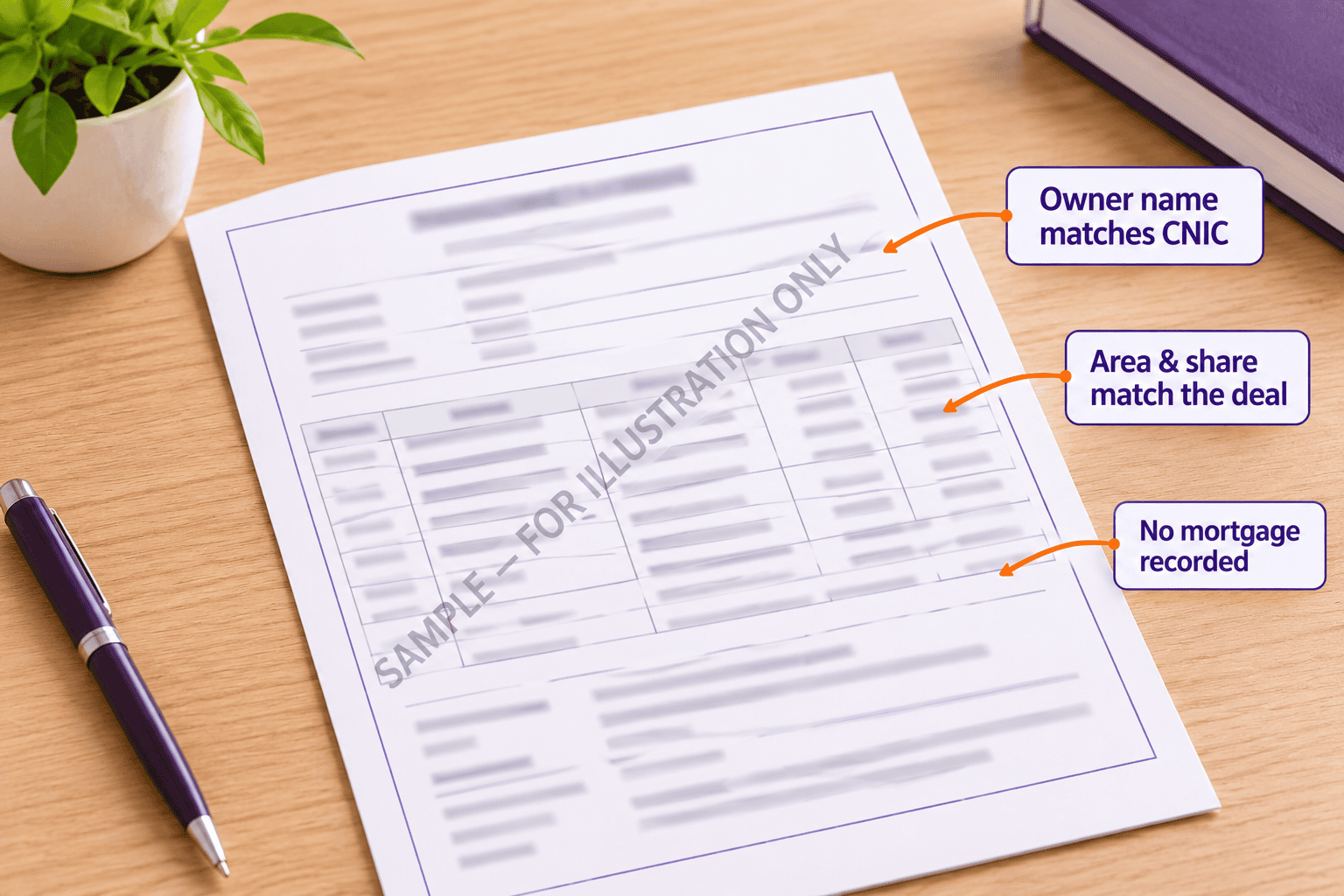
A fard is the official ownership record for land in Punjab, issued through the Punjab Land Records Authority (PLRA) at Arazi Record Centres. Get a fresh copy yourself, and check that the seller’s name, share and area match the deal exactly.
- The seller’s name matches their CNIC, spelling included.
- The area and share match what you’re buying. If the land has several owners, the seller can only sell their own share.
- No mortgage or other encumbrance is recorded against it.
- The copy is recent. Don’t rely on an old copy the seller gives you.
For property in a private society or developer project, ownership is usually shown by an allotment or transfer letter rather than a fard. Verify it directly with the society office and confirm the file is in the seller’s name.
Checking for Loans, Disputes and Unpaid Dues
A clean title can still carry hidden problems.
| What to check | How to check it |
| Bank loan or mortgage | Fard entries, plus a written declaration from the seller in the sale agreement |
| Court cases or disputes | Ask your lawyer to check, and ask neighbours and the society office |
| Inheritance issues | If the property was inherited, confirm all legal heirs have consented and the inheritance mutation is complete |
| Society dues | A No Demand Certificate (NDC) from the society |
| Utility bills | The latest paid electricity, gas and water bills |
| Property tax | Paid receipts from Excise & Taxation Punjab |
Also visit in person. Make sure the property physically exists, matches the plot or unit number, and isn’t occupied by a tenant or anyone else who claims a right to it.
Red Flags That Should Stop the Deal
Pause, or walk away, if you notice any of these:
- Pressure to pay bayana today “because another buyer is waiting”
- Cash-only payment, or payment into a personal account instead of the company’s
- A price far below the market for that area
- A seller who won’t meet in person, or deals only through a power of attorney you can’t verify
- Vague approval answers, such as “approval is in process, don’t worry”
- Name mismatches between the CNIC, the fard and the agreement
- Open files with no plot number sold as a “guaranteed” plot
- Promises of guaranteed profit in a short time
A few extra days of checking costs far less than a disputed property.
Step 5: Know Your Transfer Route: Registered vs Society Property
A property that passes verification still raises one practical question: how will ownership actually move to you? The answer decides which documents you need, which offices you visit and what “complete ownership” means for your deal.
In Lahore, most transfers follow one of two routes.
Registered Property: Registry + Intiqal
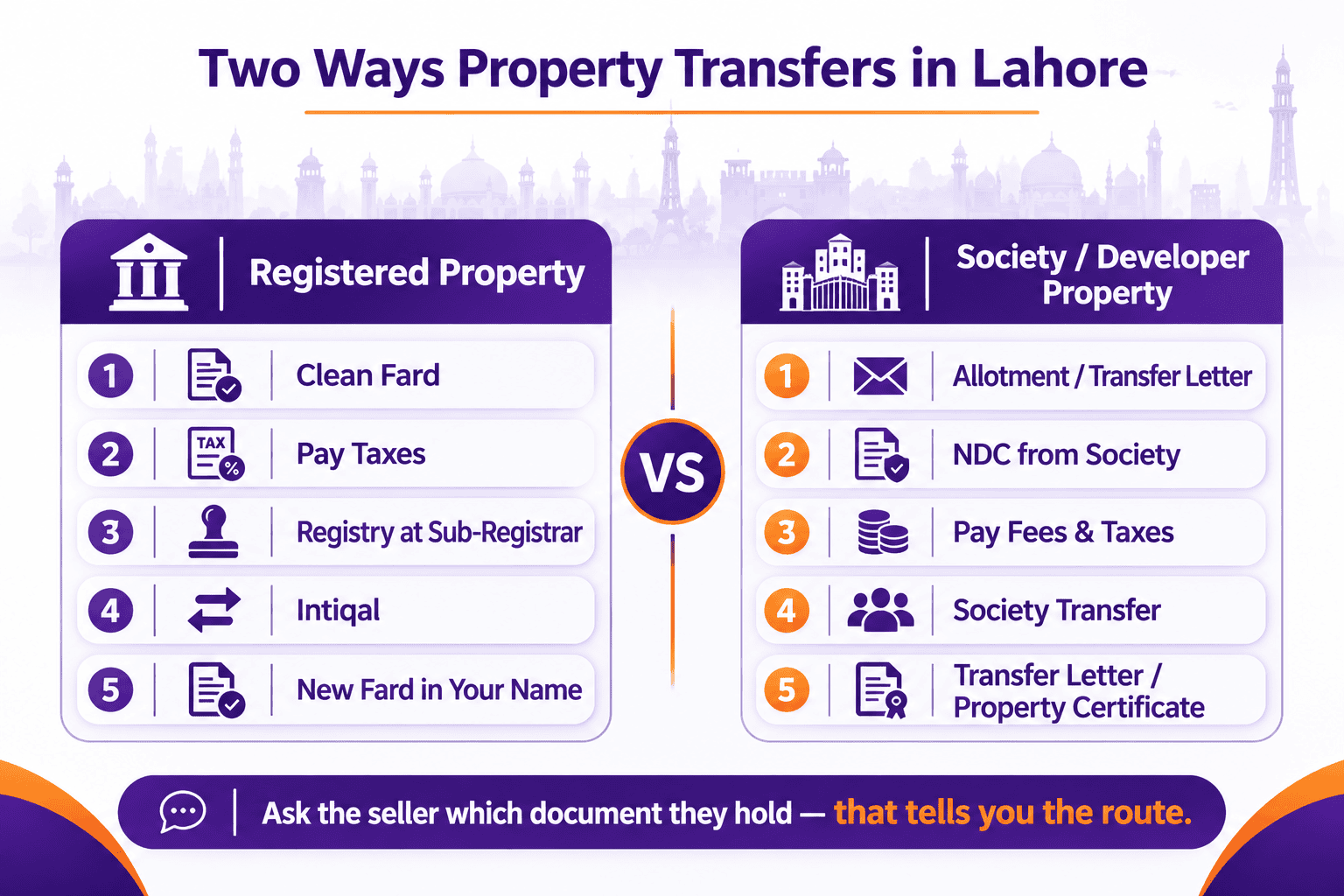
Land and houses recorded in the government revenue record transfer in two stages. First, the sale deed is registered at the Sub-Registrar office (registry). Then the land record is updated in the buyer’s name (intiqal, also called mutation). You need both.
This route usually applies to houses and plots in established areas, land outside private societies, and any property where the seller’s proof of ownership is a fard.
- The sale agreement is signed and the agreed payments are made
- Taxes and duties are paid through official challans
- The sale deed is registered at the Sub-Registrar office
- Intiqal updates the revenue record to show the buyer as owner
- The buyer collects a new fard in their own name
The common mistake is stopping at step 3. Until intiqal is done, the government record still names the seller, which can cause trouble when you sell, inherit or borrow against the property.
Society or Developer Property: Allotment + Transfer Letter
In most private housing societies and developer projects, the society or developer keeps the ownership record. The first buyer receives an allotment letter. On resale, the society processes the transfer and issues a transfer letter in the new buyer’s name.
This route usually applies to plots, houses and townhouses inside private societies, units bought directly from a developer, and any property where the seller holds an allotment letter, transfer letter or membership file.
Each society sets its own process, documents and fees, so get its transfer requirements in writing before you pay bayana.
Buying a “file” without a confirmed plot number is a different and riskier deal than buying an allotted plot or a built unit. Our comparison of Pine Homes townhouses vs plot files explains the difference.
Side-by-Side Comparison
| Registered property | Society / developer property | |
| Ownership proof | Fard and registered sale deed | Allotment letter or transfer letter |
| Who keeps the record | Government revenue record (PLRA) | Society or developer office |
| Where the transfer happens | Sub-Registrar office, then intiqal | Society office |
| Key clearance document | Clean fard and tax receipts | NDC from the society |
| Fees set by | Government | The society, plus government taxes |
| Ownership is complete when | Intiqal is approved and a new fard is issued in your name | The transfer letter is issued in your name |
| Risk if you stop early | The old owner still appears in the land record | The society doesn’t recognise you as owner |
To find out which route applies, ask the seller what document they hold. A fard points to registry and intiqal. An allotment or transfer letter points to the society route. If they can’t show either, go back to Step 4.
Step 6: Pay Bayana and Sign the Sale Agreement
Once you know the transfer route, you can commit to the deal. Bayana is the point where it stops being a conversation: you pay token money, the seller takes the property off the market, and both sides agree a price and a deadline.
Bayana is an advance payment that confirms the deal. Always pay it against a written sale agreement that states the price, the payment schedule, the transfer deadline and what happens if either side backs out.
There’s no fixed legal amount for bayana. Buyer and seller agree it between themselves. Pay only what you could afford to lose if the deal falls through on your side.
What Your Sale Agreement Must Include
A handwritten note or a WhatsApp message isn’t enough. Have the agreement written on stamp paper, ideally drafted or reviewed by a property lawyer, and signed in front of witnesses.
| Clause | What it should say |
| Parties | Full names, CNIC numbers and addresses of buyer and seller (and any attorney) |
| Property details | Exact address, plot or unit number, area, and khasra or society file number |
| Ownership proof | The document the seller holds: fard, allotment letter or transfer letter |
| Total price | In numbers and words |
| Bayana | Amount, date and payment method |
| Payment schedule | Remaining amount and the deadline for each payment |
| Transfer deadline | The date by which registry or the society transfer will be completed |
| Who pays what | Which taxes, fees and dues each side covers |
| Seller’s declarations | No loans, disputes, other buyers or unpaid dues |
| Possession | When, and in what condition, the property will be handed over |
| Default clause | What each side loses if they back out |
| Witnesses | Names, CNICs and signatures |
The default clause matters most. Spell out what happens if the buyer backs out, and also what the seller owes you if they back out. That protection only exists if it’s written down.
Attach copies of both CNICs, the seller’s ownership document and any NDC to the agreement.
Safe Ways to Make Payment
Pay by pay order, demand draft or bank transfer, made out to the seller named on the ownership document, or to the developer’s company account. Get a signed receipt for every payment.
- Avoid cash. If something goes wrong, a cash payment is very hard to prove.
- Pay the actual owner. The payee should match the fard, the allotment letter or the company name. Never pay into a dealer’s or relative’s personal account.
- For developer bookings, pay only into the company’s official account and get a receipt on company letterhead.
- Keep a payment file with every pay order, bank slip and receipt, alongside the agreement.
- Match each payment to the schedule you both signed.
Step 7: Pay Taxes and Transfer Fees
With the agreement signed, the numbers from your Step 2 worksheet become real payments. Registry and society transfers usually won’t go ahead until the taxes are paid, so this step can’t be left until the last day.
Tax rates in Pakistan change often, usually with each federal and provincial budget. The rates below are deliberately left blank. Confirm the current figures with FBR, the Punjab government or your lawyer before you calculate.
When property changes hands in Lahore, the buyer typically pays advance tax on purchase, stamp duty, CVT where applicable, and registration or transfer fees. The seller typically pays advance tax on sale and, where it applies, capital gains tax. Filer status affects the rates for both.
Taxes the Buyer Pays
| Tax or fee | Charged by | Based on | Current rate |
| Advance tax on purchase (Section 236K) | FBR | Property value, often the FBR valuation | 1.25% (all values). Non-filer: 10.5% up to Rs 50M, 14.5% Rs 50–100M, 18.5% above Rs 100M |
| Stamp duty | Punjab government | Property value | 1% for urban and rural property (Stamp Amendment 2026) |
| Capital Value Tax (CVT), where applicable | Punjab government | Property value | 2% on urban property. Rural property generally exempt. Confirm on your challan |
| Registration fee | Board of Revenue / PLRA | Registry of the sale deed | Rs 500 (value up to Rs 5 lakh) or Rs 1,000 (above), plus PLRA e-registration charge of 0.1% (minimum Rs 3,600) |
| Society transfer fee | Society or developer | Set by the society, often by size | Get it in writing |
- Valuation decides the bill. Taxes are usually based on the official valuation (FBR valuation table or DC rate), which may differ from your agreed price.
- Pay only through official channels, using bank challans or the government’s online payment systems, and e-stamp paper for stamp duty in Punjab. Never hand tax money to a middleman in cash.
- Keep every paid challan. You’ll need them at registry or the society office, and again when you sell.
Taxes the Seller Pays
These are the seller’s costs, but they affect your deal. If they aren’t paid, the transfer can stall.
| Tax | Charged by | Notes |
| Advance tax on sale (Section 236C) | FBR | Paid before transfer. The rate depends on filer status and value |
| Capital gains tax | FBR | Depends on the holding period and current rules |
| Society dues and NDC charges | Society | Must be cleared before the NDC is issued |
Your sale agreement should state clearly which side pays each item, so there are no arguments at the registry counter.
Filer vs Non-Filer: How Much Difference?
Buyers and sellers on FBR’s Active Taxpayer List (filers) pay lower advance tax rates than non-filers, and the gap can be large. Recent budgets have also tightened the rules on property purchases by non-filers.
- Check your own status on FBR’s Active Taxpayer List.
- Check the seller’s status, because it affects their tax and can delay the transfer.
- If you’re a non-filer, ask a tax adviser whether filing your return before the purchase would lower your tax.
- Check any purchase restrictions for non-filers or “ineligible persons” under the current Finance Act.
For the latest changes, read real estate tax reforms in Pakistan 2026 and Pakistan Budget 2026-27 and real estate.
Step 8: Complete the Registry or Society Transfer
With the challans paid, the formal transfer can take place. This is the day ownership changes hands, and it’s where one missing document or one mismatched name can cost you a second trip.
Registry at the Sub-Registrar (e-Registry)
For registered property, the sale deed is prepared on stamp paper. Both parties then appear at the Sub-Registrar office with their documents and paid challans, and the deed is registered in the buyer’s name. In Lahore, registry is done through the e-registration system.
What to bring:
| Document | Provided by |
| Original CNICs and copies (NICOP for overseas Pakistanis) | Buyer and seller |
| Fresh fard | Seller, from the Arazi Record Centre |
| Sale deed on stamp paper | Your lawyer or deed writer |
| Paid tax and duty challans | Both sides, as agreed |
| Passport-size photographs | Buyer and seller |
| Registered power of attorney, if anyone isn’t attending | The absent party |
| Any required NOC | Depends on the property |
| Two witnesses with CNICs | Arranged in advance |
On the day:
- Documents are checked. Names, CNIC numbers, property details and challan amounts must match.
- Buyer, seller and witnesses are verified.
- The seller confirms the sale before the registering officer.
- The deed is registered and recorded.
- You receive the registered sale deed, or a receipt to collect it later.
Settle the final payment at registry, once the seller has confirmed the sale, rather than before. Your agreement should say exactly when the last payment is due. Before you leave, check that your name, CNIC number and the property details are correct on the deed.
Society Transfer: NDC to Transfer Letter
For property in a private society or developer project, the society office handles the transfer. The seller clears all dues and gets an NDC, both parties submit the documents and pay the fees, and the society issues a transfer letter in the buyer’s name.
Every society has its own forms and fees, so ask for its written transfer checklist. It usually includes:
| Document | Notes |
| Original allotment or transfer letter | Held by the seller |
| No Demand Certificate (NDC) | Issued once all dues are cleared |
| CNIC copies of buyer and seller | Sometimes attested |
| Passport-size photographs | Buyer and seller |
| Society transfer forms | Filled in and signed |
| Paid transfer fee and tax challans | The society’s fee plus government taxes |
| Affidavits or undertakings | If the society requires them |
| Registered power of attorney | If either party isn’t attending |
What usually happens:
- The seller applies for the NDC and clears any pending dues
- Both parties attend the society office on the transfer date
- Identity is verified, often through biometrics or photographs
- Fees and taxes are paid and receipts attached
- The society issues a transfer letter in your name and updates its records
If the unit is still being paid in installments, ask how the remaining schedule moves to you. Then confirm that the society has updated your contact details and nominee, because future notices and possession letters go to whoever is on the file.
Step 9: Get Intiqal Done and Collect Your New Fard
For society property, the transfer letter completes the paperwork. For registered property, one step is still left. The registered sale deed proves the sale happened, but the government land record still has to show you as the owner. That update is called intiqal, or mutation.
Intiqal updates the revenue record in Punjab to name the buyer as the new owner after registry. Once it’s approved, you can get a new fard in your own name. That fard is the clearest proof of ownership for registered property.
Skip it, and the record keeps showing the seller. That causes problems when you sell, take a bank loan against the property, pass it to your children, or if the seller or their heirs ever claim it.
How intiqal works:
- Start after registry. Depending on the current system, intiqal may move forward automatically after e-registry or need a separate application.
- Submit the documents, usually a copy of the registered deed, CNIC copies and paid challans.
- Verification and approval. The record is checked against the deed, and the mutation is entered and approved.
- Collect your new fard from the Arazi Record Centre.
Check the new fard carefully:
- Your name and CNIC number are correct
- The area and share match your sale deed
- The seller no longer appears for the share you bought
- No unexpected encumbrance has appeared
If intiqal is delayed, follow up in person with your registry receipt and application reference, and ask your lawyer to step in if someone raises an objection or the delay drags on.
Store the registered deed, new fard, challans and receipts together, as physical originals and scanned copies.
Step 10: Take Possession the Right Way
Paper ownership is complete. Possession is the physical side: keys in hand, doors open, and future bills in your name. It’s also your last chance to find problems while the seller or developer is still responsible for fixing them.
- Resale property: Possession is usually handed over at or soon after transfer, on the date in your sale agreement.
- New property from a developer: The developer issues a possession letter once construction is complete and any possession-stage payment is cleared.
Either way, inspect before you accept the keys.
Handover Inspection Checklist
Inspect the structure, finishing, plumbing, electrical work and fittings, and confirm that all dues are cleared. Record any defects in writing so they’re fixed before or after handover. Visit in daylight, and bring someone who understands construction if you can.
| Area | What to check |
| Structure | Cracks in walls, ceilings or columns. Seepage or damp |
| Roof | Waterproofing, drainage, leaks |
| Plumbing | Pressure in every tap, leaks under sinks, drainage, geyser |
| Electrical | Every switch, socket and light. Distribution board and earthing |
| Doors and windows | Smooth opening and closing, working locks, no gaps |
| Floors and tiles | Hollow or broken tiles, uneven surfaces |
| Kitchen and bathrooms | Fittings, cabinets, exhaust, leakage |
| Finishing | Paint, plaster, and anything promised in the agreement or brochure |
| Agreed fixtures | Fans, lights, ACs, wardrobes, whatever was included |
| Meters | Installed, with readings noted on the day |
Take dated photos and ask the seller or developer to sign a handover note listing what will be fixed and by when. For a new home, ask about any defect liability or warranty period.
Utility Connections and Name Change
Move utilities and records into your name quickly. Otherwise bills and notices keep going to the previous owner, and unpaid dues can land on you.
- Record final meter readings and collect the latest paid bills from the seller.
- Electricity (LESCO): Apply for a change of name.
- Gas (SNGPL): Apply for a change of ownership.
- Water and sewerage: Update the WASA Lahore connection, or register with the society if it manages water.
- Society records: Register as the resident for maintenance, security and gate access.
- Property tax: Update the owner’s name with Excise & Taxation Punjab.
Special Cases: Installment Buyers and Overseas Pakistanis
The 10 steps cover a standard purchase. Two groups of buyers follow a slightly different route: people buying new from a developer on installments, and overseas Pakistanis buying from abroad. The core rules stay the same. Verify first, pay through traceable channels, and get everything in writing.
How Buying From a Developer on Installments Works
When you buy from a developer on installments, you book a specific unit with a booking amount, confirm it with a second payment, and receive booking or allotment documents. You then pay installments on a fixed schedule. Possession follows the developer’s timeline, sometimes before the last installment.
| Resale property | Developer installment purchase |
| Verify the seller’s ownership | Verify the developer and the project’s approvals |
| Bayana and sale agreement | Booking amount and signed booking terms |
| Full payment at transfer | Installments over months or years |
| Registry or society transfer | Allotment letter in your name |
| Possession at transfer | Possession after construction, through a possession letter |
Before booking, get these in writing:
- The full payment schedule: booking, confirmation, installments, any lump sums and the possession payment
- The total price, and whether it can change
- The expected possession timeline, and what happens if it slips
- Late-payment terms: penalties, grace periods and the consequences of missed installments
- The transfer and cancellation policy, including charges and refunds
- Exact unit details: unit number, floor, covered area and specifications
Example: Pine Homes in Union Town. Here is how the process works at Barir Developers’ Pine Homes project, which offers 2-bedroom townhouses in Union Town, Lahore. Under the current plan, buyers:
- Visit the sales office or the site and choose a specific townhouse unit
- Submit a CNIC copy, passport-size photographs, the nominee’s CNIC copy and, if required, proof of address
- Pay the booking amount and then a confirmation payment, by pay order, demand draft, bank transfer or crossed cheque made out to Barir Developers
- Follow a 3-year payment plan made up of monthly installments, semi-annual payments and an on-possession payment
- Receive possession on the project’s expected timeline, which is planned before the payment period ends
Prices, installment amounts and timelines can change, so confirm current terms before booking. The full walkthrough is in our Pine Homes booking guide. Current plans are on the payment plans page, and unit details are on the 4 Marla and 5 Marla townhouse pages.
How Overseas Pakistanis Can Buy Without Visiting
Overseas Pakistanis can buy property in Lahore remotely. They appoint a trusted person through a properly attested and registered power of attorney, send payments only through banking channels, and verify the property through official records and live video.
- Choose your representative carefully, and limit the POA to this specific property and transaction instead of signing a general POA.
- Get the POA attested and registered. A POA signed abroad usually needs attestation at a Pakistani embassy or consulate, then registration or validation in Pakistan.
- Use your NICOP as your identity document throughout.
- Verify properly from abroad. Have your representative collect a fresh fard or society record directly, and do a live video walkthrough of the property and the area.
- Send money only through banking channels, to the seller named on the ownership document or the developer’s company account. Ask your bank whether a Roshan Digital Account can be used for your purchase.
- Collect scans of every receipt, challan, agreement and transfer document as each stage is completed.
- Inspect before possession if you can, yourself or through someone you trust.
Our overseas Pakistanis property guide for Lahore and the overseas buyer’s townhouse guide cover remote buying in more detail.
Document Checklist for Property Buyers in Lahore
Whichever route you take, paperwork causes most delays. To buy property in Lahore you typically need CNICs (or NICOPs) for buyer and seller, the seller’s ownership document, a written sale agreement, paid tax challans and passport-size photographs. Society property also needs an NDC, and developer bookings usually ask for a nominee’s CNIC.
Save or print this list and tick items off as you go.Keep originals in one folder and scans in a secure cloud folder. Then check every name and number across the documents. A single wrong CNIC digit is one of the most common reasons a transfer gets held up.
Frequently Asked Questions
What is the property buying process in Lahore?
The property buying process in Lahore has 10 steps. Choose the property type, work out your total budget, shortlist the area and developer, and verify approval and ownership. Then confirm the transfer route, pay bayana against a written sale agreement and pay the applicable taxes. Finally, complete the registry or society transfer, get intiqal done for registered property, and take possession after an inspection.
Which documents are required to buy property in Lahore?
You typically need CNICs for buyer and seller (NICOP for overseas Pakistanis), the seller’s ownership document, a sale agreement on stamp paper, paid tax challans and passport-size photographs. The ownership document is a fard for registered property, or an allotment or transfer letter for society property. Society transfers also require an NDC, and anyone acting through an attorney needs a registered power of attorney.
How do I check if a property or housing society is legal in Lahore?
Check the society against the Lahore Development Authority’s list of approved and illegal housing schemes. Confirm that your specific block or phase is approved, and get the NOC or approval reference in writing. Then verify ownership through a fresh fard or society records, and check for loans, disputes and unpaid dues before you pay anything.
What is the difference between registry and intiqal?
Registry is the registration of the sale deed at the Sub-Registrar office, which legally records the sale. Intiqal (mutation) comes after registry and updates the government land record to show the buyer as the new owner. Registered property needs both. Without intiqal, the official record still names the seller, which causes problems when you sell or pass the property on.
How long does property transfer take in Lahore?
It depends on the transfer route and how complete the documents are. A registered property with clean papers moves faster than one with missing documents or inheritance issues, and intiqal is often the slowest stage. Society transfers follow each society’s own process. Collecting documents early and matching every name avoids most delays.
What taxes does a buyer pay when buying property in Pakistan?
A buyer in Lahore typically pays advance tax on purchase under Section 236K, stamp duty, Capital Value Tax where applicable, and registration or society transfer fees. Rates depend on the property’s official valuation and on whether you’re on FBR’s Active Taxpayer List. Rates change with budgets, so confirm the current figures before calculating.
Can overseas Pakistanis buy property in Lahore without visiting?
Yes. Overseas Pakistanis can appoint a trusted person through a power of attorney that has been attested abroad and registered or validated in Pakistan. Use your NICOP, verify the property through official records and live video, and send payments only through banking channels to the seller named on the ownership document or the developer’s company account.
Is it safe to buy property on installments from a developer?
It can be, if you check the right things first. Verify the developer’s completed projects and the approval of the specific phase, and get the full payment schedule, possession timeline and transfer or cancellation policy in writing. Pay only into the company’s official account and collect a receipt for every payment. Visit the site more than once to see progress yourself.
Do I need a lawyer to buy property in Lahore?
The law doesn’t require one, but a property lawyer is strongly recommended, especially for registered, inherited or high-value property. A lawyer can check the title chain and fard, look for disputes, draft a sale agreement with proper default clauses and guide you through registry and intiqal. Compared with the money at stake, the fee is small.
How can I avoid property scams in Lahore?
Never pay bayana before verifying the property. Confirm LDA approval for the exact block, check ownership through a fresh fard or society records, and make sure the seller’s name matches their CNIC. Avoid cash and personal accounts. Be wary of prices far below market, pressure to pay immediately, open files without plot numbers and promises of guaranteed returns.
Before You Sign: Final Advice
Every serious problem in a Lahore property deal, whether fraud, a disputed title or a stalled transfer, becomes much harder to fix once money has changed hands. Verification takes a few days. Skipping it can cost years.
Before you sign anything, make sure you can answer yes to each of these:
- Is the society or project approved, including your exact block or phase?
- Does the seller’s name match their CNIC and the fard or allotment letter exactly?
- Do you know whether you’re on the registry-and-intiqal route or the society route?
- Have you budgeted for the full cost, using current tax rates?
- Are the price, schedule, transfer deadline, possession date and default terms all in writing?
- Is every payment traceable, made to the right name, with a receipt?
- Has a lawyer, or someone experienced, checked the papers?
And keep a few habits. Don’t let urgency make the decision for you. Ask the awkward questions, since a reliable seller or developer won’t mind showing documents. Keep your property file complete for the day you sell. Recheck the rules before every deal, because what applied to a friend’s purchase last year may not apply to yours.
Considering a Townhouse in Union Town, Lahore?
If you’re planning to buy from a developer on installments, our team can take you through the booking steps, required documents and current payment plan for Pine Homes in Union Town, and answer questions about any step in this guide. You’re welcome to visit the site before you decide.
Contact Barir Developers to schedule a visit, or read the Union Town Lahore complete guide first.
