Property Investment in Lahore: A Practical 2026 Guide
Last updated: October 2026 · Written by Usama Saleem ·
Quick Answer: Property investment in Lahore can still make sense in 2026, but only when the basics are right: an approved project, a location with real development and demand, a payment plan you can comfortably afford, and the patience to hold for several years. Lahore rewards careful, documented buying. It punishes rushed decisions made on promises.
You have some savings. Your bank balance isn’t growing the way you hoped, and everyone around you says the same thing: “Property le lo, kabhi nuqsan nahi hota.” Then you start looking, and the confusion begins. Every dealer has a “golden opportunity.” Every society claims it will double in value. And somewhere in the back of your mind is a story about a relative who lost money on a file that never became a plot.
This guide to property investment in Lahore is written for that moment. You’ll learn whether real estate investment in Lahore still makes sense in 2026, which property types suit which goals, how capital appreciation and rental yield work, what taxes and costs to expect, how to check an approved housing scheme, and what overseas Pakistanis should do differently. No hype and no invented numbers, just the decisions you need to make, in the order you need to make them.
Is Property Investment in Lahore Still Worth It in 2026?
For most patient, careful buyers, yes. Lahore remains one of Pakistan’s most active property markets, and the reasons people buy here haven’t disappeared. But “worth it” depends far more on what you buy and how you buy it than on the city itself. A documented home in a developing, occupied community is a very different investment from an unverified file bought because a dealer said the rate would rise tomorrow.
The honest answer has two parts: why demand holds up, and what can go wrong.
What Keeps Demand Strong
Lahore is the capital of Punjab and one of the country’s largest cities. People keep moving here for jobs, education and healthcare, and families who already live here keep upgrading. That steady need for housing sits under everything else.
Several factors support demand in 2026:
- Road infrastructure. The Lahore Ring Road and the corridors connected to it, such as Raiwind Road, have made areas that once felt distant practical for daily commuting. When travel time drops, interest in those areas usually rises.
- A shift toward planned communities. More buyers now prefer gated societies with boundary walls, maintained parks and controlled entry over unplanned neighborhoods.
- Installment buying. Many developers offer payment plans, letting salaried families enter the market years earlier than if they had to pay in full.
- Lower transaction taxes for filers. Under Budget 2026-27, buying and selling became cheaper for people on the Active Taxpayers List. Our breakdown of the Budget 2026-27 property tax rates explains what changed.
- Overseas Pakistanis. Pakistanis living abroad have long been active buyers in Lahore, purchasing homes for parents, for their own return or as long-term assets. Some are also weighing Pakistan against Gulf markets more carefully this year, a shift covered in our look at UAE vs Pakistan real estate.
None of these guarantees that a specific property will rise in value. They explain why the market as a whole keeps attracting buyers.
The Risks You Should Know Upfront
Most losses in Lahore property don’t come from the market crashing. They come from buying the wrong thing, from the wrong person, without the right checks.
- Unapproved projects and blocks. A society’s name can be well known while a particular phase or block lacks the approvals buyers assume it has.
- Files that never become plots. A file is a paper booking, not a physical piece of land. If the project stalls, it can sit for years.
- Development and possession delays. Off-plan homes are often cheaper, but you are relying on the developer finishing on time.
- Liquidity. Property is not a bank account. Selling quickly can mean accepting a lower price.
- Hidden costs. Taxes, transfer fees, maintenance and possession charges add up.
- Hype pricing. Paying too much for “future potential” can wipe out years of growth before it starts.
- Changing rules. Tax rates and regulations are revised in every annual budget.
| Why investors choose Lahore | What can hurt them |
| Steady housing demand from a large city | Unapproved blocks and paper files |
| Improving road connectivity | Development and possession delays |
| Planned, gated communities | Difficulty selling quickly |
| Installment plans lower the entry barrier | Taxes and charges left out of the budget |
| Lower 2026 transfer taxes for filers | Overpaying because of hype |
Almost every risk on that list can be reduced with simple checks, and this guide covers them step by step. If you want to start with the most important one, read our guide on how to verify a real estate developer.
Before You Invest: Know Your Goal, Budget and Timeline
Checking a developer protects you from the wrong project. But many buyers make an earlier mistake: they start visiting societies before they know what they want the property to do for them.
Two people can buy the same 5 Marla home on the same street and get completely different results. One wanted monthly rent and got it. The other needed to sell within eighteen months, couldn’t find a buyer at the right price and felt stuck. The property wasn’t the problem. The plan was.
So before you open a single listing, answer three questions honestly.
Rental Income or Capital Growth?
Property earns money in two ways, and most properties lean toward one.
- Rental income is the money you collect from a tenant each month. It suits people who want regular cash flow, such as retirees, families building a second income, or overseas owners who want the property to pay for itself.
- Capital growth, also called capital appreciation, is the increase in the property’s value over time. You only receive it when you sell, so it suits people who can wait.
Your goal shapes what you should buy. An empty plot can grow in value but earns no rent. A finished house or townhouse in an occupied community can be rented after possession but needs maintenance and a reliable tenant.
Ask yourself: Do I need this property to pay me every month, or am I building value for later? If the answer is “both,” decide which matters more. Few properties are the best at both.
Short-Term vs Long-Term Holding
Short-term buying, selling within a year or two, is the riskiest approach. You pay transaction costs when you buy and again when you sell, and prices in one area may not move enough in that time to cover both.
Long-term holding, five years or more, gives a property time to benefit from new roads, more residents and maturing amenities, while spreading your buying costs over more years. For most buyers in Lahore, especially in developing communities, the longer horizon is the safer one.
A practical test: if you couldn’t leave this money untouched for at least three to five years without stress, property may not be the right place for all of it.
How Much Risk Can You Handle?
- Lower risk: ready or nearly complete homes in established or clearly developing blocks, from a developer with visible progress and verifiable approvals. Usually a higher entry price, with fewer surprises.
- Medium risk: off-plan homes on installments from a verified developer, with construction underway. Lower entry price, but you depend on the timeline being met.
- Higher risk: new launches, unverified files or projects where approvals are “in process.” The lowest entry price and the highest chance of delays or disputes.
There is no shame in choosing the lower-risk route. Many Lahore families have built real wealth one well-chosen home at a time.
Your Investor Checklist
Write down these four answers before you visit any site:
- My goal: rental income, capital growth, or a future family home?
- My budget: the total I can invest, including taxes and charges.
- My timeline: how many years I can hold without needing to sell.
- My risk level: ready, off-plan or new launch?
With these answers in hand, you are matching options to a plan instead of reacting to whatever a dealer shows you first.
Which Type of Property Should You Invest In?
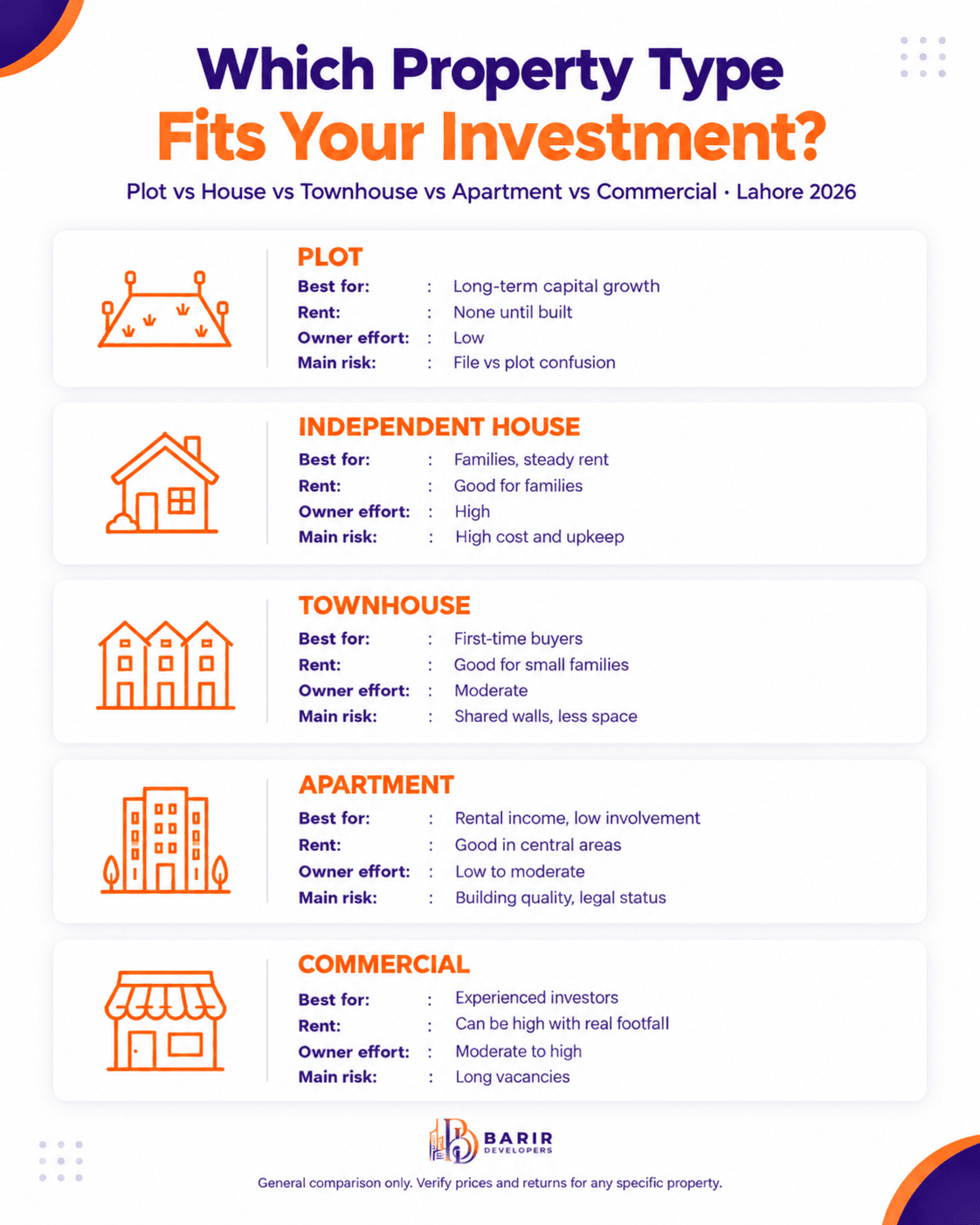
Once your plan is clear, the next decision is the asset itself. Most investors in Lahore choose between five property types, plus one timing choice: something already built, or something still under construction.
Plots
A plot is land you own and can build on later, within the society’s rules. Plots are simple to hold: no tenants, no repairs, no wear and tear.
Best for: long-term capital growth.
Be careful about: plots earn no rent, and their value depends on whether the surrounding area actually develops. Confirm that you are buying a numbered, demarcated plot with clear ownership, not a file.
Independent Houses
An independent house stands on its own plot with no shared walls, offering the most privacy and the most freedom to extend within society rules.
Best for: families who may live there later, and investors seeking rental demand from larger households.
Be careful about: independent houses usually carry the highest price and the highest upkeep of any residential option. Our article on why an independent house can be a smart investment covers this option in detail.
Townhouses
A townhouse is a multi-storey home that shares one or both side walls with its neighbors but has its own entrance and living space across several floors. In Lahore, townhouses have become a popular middle ground for families who want a house-like feel without the cost of a standalone home.
Best for: first-time buyers, young families, and investors who want a rentable family home at a lower entry point than an independent house.
Be careful about: shared walls, less outdoor space and limited room to extend. Our guide to townhouses in Lahore explains sizes and what to check.
Apartments
Apartments are often the lowest entry point into Lahore property. Building management usually handles security and common areas, which suits owners who live abroad.
Best for: rental-focused investors in central or well-connected locations, and buyers who want low day-to-day involvement.
Be careful about: you own a unit, not land, so long-term value depends on building quality, management and legal status. Service charges also reduce your net return. Our comparison of townhouses vs apartments in Lahore sets out the trade-offs.
Commercial Property
Shops, offices and units in mixed-use buildings can earn higher rents than homes when they sit in a location with real footfall. A shop in a busy market is a very different asset from one in a half-empty plaza.
Best for: experienced investors with larger budgets who understand tenant demand.
Be careful about: long vacancies, and resale that depends on the success of the whole building. Judge the location by what is open and busy today.
Off-Plan vs Ready-to-Move
This isn’t a property type, but it changes the whole investment.
- Off-plan means buying before construction is complete, usually on installments. The entry price is often lower and payments are spread out, but you wait for possession and carry the risk of delays.
- Ready-to-move means the property is built and can be used or rented right away. You pay more upfront, but you see exactly what you are buying.
If you need rental income soon, off-plan won’t help. If you can wait, it can be the most affordable way in. Our guide to off-plan vs ready-to-move property in Lahore explains how to choose.
Property Types Compared at a Glance
| Property type | Typical entry level | Rental potential | Owner effort | Ease of resale | Main risk |
| Plot | Varies widely by area and size | None until built | Low | Depends on area development | Approval and file confusion |
| Independent house | Usually the highest | Good for families | High | Strong in occupied areas | High cost and upkeep |
| Townhouse | Below a comparable house | Good for small families | Moderate | Depends on the community | Shared walls, limited space |
| Apartment | Often the lowest | Good in central locations | Low to moderate | Depends on the building | Building quality, legal status |
| Commercial | Varies; often high | Can be high with real footfall | Moderate to high | Depends on the building | Long vacancies |
General comparison only. Actual prices and returns vary by location, size and project.
The property type narrows your options. Whether that property holds its value depends on where it is.
Best Areas for Property Investment in Lahore
A good property in the wrong location rarely becomes a good investment. Location decides who will want to rent or buy from you later, how quickly the area develops and how easily you can sell.
There is no single “best area.” Lahore’s options fall into three broad groups, each suited to a different budget and level of patience.
Established Areas: DHA, Bahria Town and Gulberg
These are Lahore’s well-known, mature addresses, where families already live and schools, hospitals and markets are operating.
- DHA Lahore: Its older phases are fully settled with an active resale market. Newer phases can be far less developed, so the name alone doesn’t tell you how a particular phase will perform.
- Bahria Town Lahore: A large, self-contained community with schools, healthcare, commercial areas and parks inside the gates. Development and occupancy differ by sector.
- Gulberg: A central area known for commercial activity, offices and high-rise apartments.
Why investors choose them: stronger resale demand, established rental markets and fewer unknowns.
The trade-off: higher entry prices. Even here, check the exact phase, block and documents.
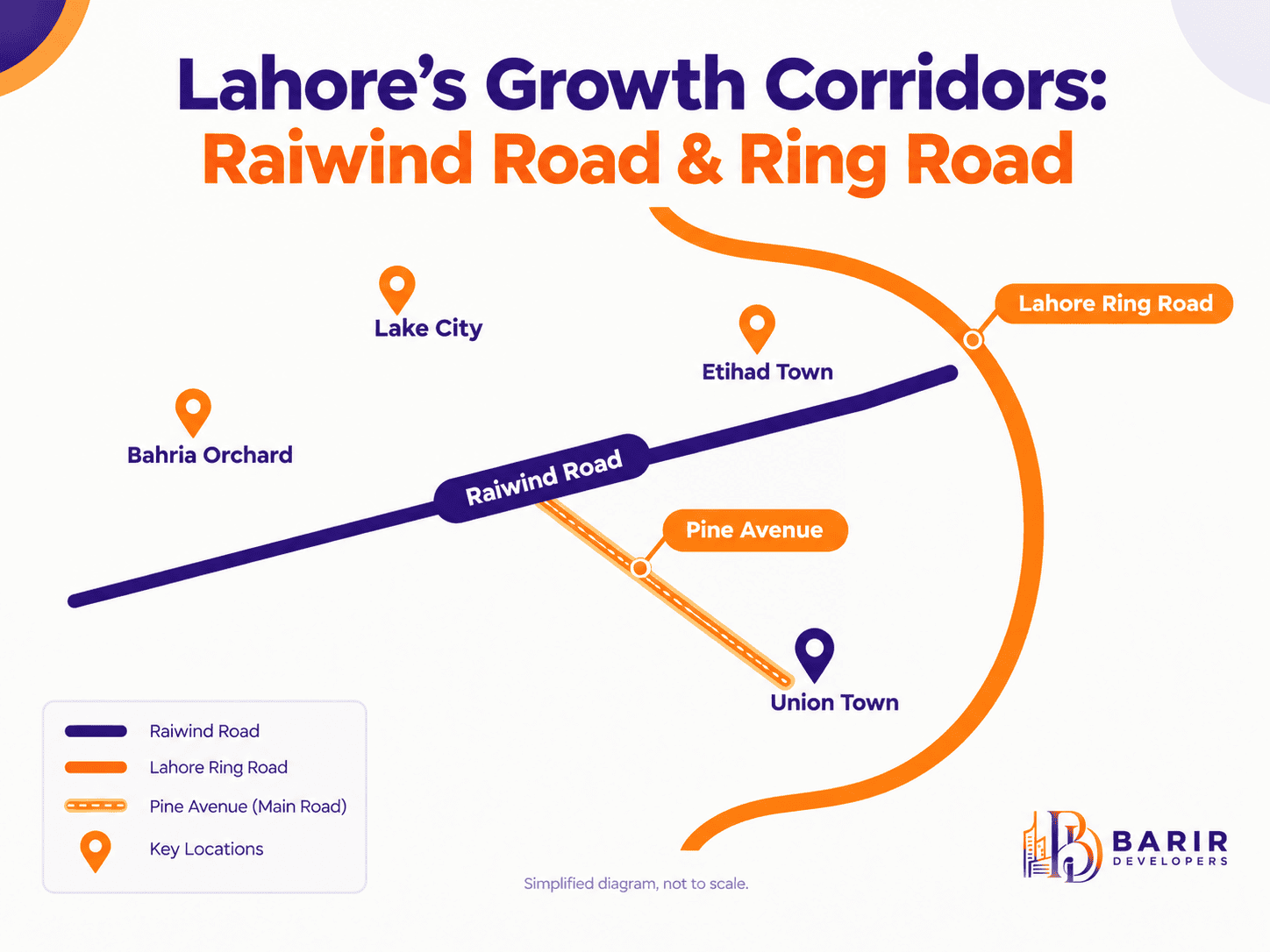
Growth Corridors: Raiwind Road and the Ring Road
Growth corridors are areas where new roads, new housing and new residents arrive together. In Lahore, much of this activity sits along Raiwind Road and the belt connected to the Lahore Ring Road.
Raiwind Road includes a mix of established and developing communities, such as Lake City, Bahria Orchard and Etihad Town. Union Town, where Barir Developers is building Pine Homes, is also in this wider area, connected to Raiwind Road through Pine Avenue.
Why investors choose them: lower entry prices than central Lahore, newer planned layouts and room for value to grow as blocks fill up.
The trade-off: more of the community is still taking shape, and commute times, amenities and occupancy vary from block to block.
To separate what exists from what is only planned:
- Drive the main access road at rush hour.
- Count the occupied homes on the street you’re considering.
- Check which schools, mosques and markets are actually open.
- Treat announced roads and projects as possibilities until construction is visible.
Affordable Gated Communities
For many middle-class buyers, the most realistic entry point is a smaller home, such as a townhouse or a 3 to 5 Marla house, in a gated community offered on installments.
Security, parks and mosques are shared by every household, so a family in a smaller home uses the same gate and park as a family in a larger one. That makes smaller units easier to rent to young families and easier to resell to first-time buyers.
The key is confirming that the community is genuinely developing, not just well marketed. Our guide to the best gated communities in Lahore compares eight societies using one checklist.
Which Areas Fit Your Budget
| Budget position | Area type to consider | Example areas | Property types that usually fit |
| Entry-level | Developing gated communities along growth corridors | Union Town, Bahria Orchard, Park View City | Apartments, townhouses, smaller houses on installments |
| Mid-range | Newer phases of established societies; developing corridors | Union Town (larger homes), Lake City, Wapda Town, Valencia Town | Townhouses, 5 to 10 Marla houses, plots |
| Higher | Mature phases of established societies | DHA Lahore (older phases), Bahria Town Lahore | Independent houses, larger plots, commercial units |
| Premium | Prime central areas | Gulberg | High-end apartments, commercial property |
Knowing where your budget fits is the first half. The second is knowing what that budget really needs to cover.
What Does It Really Cost to Invest?
Many buyers plan for the price and forget everything around it. Then the transfer day arrives with taxes, fees and charges nobody mentioned during the site visit.
The real cost has four parts: what you need to start, how you pay the rest, the taxes on the transaction, and the smaller charges that quietly add up.
How Much You Need to Start
There is no fixed minimum. As a general pattern:
- Ready properties usually require most or all of the price upfront.
- Off-plan properties usually start with a booking or down payment, followed by installments during construction.
A more useful question than “how much does property cost?” is: “How much can I pay today, and how much can I comfortably pay every month for the next few years, with a buffer?”
Keep an emergency fund separate from your property budget. If one missed salary would put your installments at risk, the plan is too tight.
Buying on Installments
Installment plans are the most common way middle-income families enter Lahore’s market. A typical plan includes a booking amount, a confirmation or down payment, regular monthly or quarterly installments, and sometimes stage payments or a final payment at possession. Structures differ by developer.
Look past the monthly figure and check:
- Total cost across the full plan
- Possession timeline, and what the agreement says about delays
- Charges due at possession, such as development or utility connection fees
- Late-payment penalties and grace periods
- Transfer rules, in case you need to sell before possession
Our installment house in Lahore guide explains how these plans work, and houses on installments in Lahore compares 3 and 5 Marla options. You can also see a structured plan on the Barir Developers payment plans page.
Using Bank Financing
Most homes in Pakistan are still bought with savings or developer installment plans rather than bank loans. Housing finance is offered by some banks, and the government has discussed measures to expand it, but eligibility, limits and markup rates vary.
If you’re considering a home loan:
- Banks generally assess your income, documents and repayment ability.
- Not every project qualifies for financing.
- Total repayment over the loan period will exceed the property price.
Our article on housing finance in Pakistan covers this route in more detail.
Taxes for Filers and Non-Filers in 2026
Under Budget 2026-27, filers on the Active Taxpayers List pay a flat advance tax when buying and selling property. Non-filers pay much higher rates.
| Transaction | Filer (from 1 July 2026) | Non-filer |
| Buying (Section 236K) | 1.25% | 11% |
| Selling (Section 236C) | 2.75% | 11% |
On a property with an official value of Rs 1 crore, a filer buyer would pay Rs 125,000 in advance tax at 1.25%. For most buyers, becoming a filer saves far more than it costs. Full details, including non-filer rates, are in our guide to Budget 2026-27 property tax rates.
Transfer Charges Buyers Often Forget
Depending on the property, a buyer in Lahore may also pay:
- Stamp duty to the Punjab government
- Registration and PLRA fees for recording the transfer
- Society transfer fee and no-demand certificate (NDC) charges
- Possession charges for new homes, such as development or utility connection fees
- Professional fees for a lawyer or deed writer, and any dealer commission
- Monthly maintenance charges after possession
Before paying any token money, ask for a written cost sheet listing every charge and who pays it. If a charge isn’t written down, assume you will be paying it.
Rental Income vs Capital Growth: How to Judge Returns
Knowing the full cost tells you what you’re putting in. The harder question is what you can reasonably expect back, and this is where many conversations with dealers go wrong. “It will double in a few years” and “it will earn great rent” are not statements you can check.
The better approach is to understand how returns work and judge each property yourself. Property earns money in only two ways: the rent it produces and the increase in its value. You can measure the first today. The second you can only estimate.
How to Calculate Rental Yield
Rental yield shows how much rent a property earns each year compared with what you paid. It lets you compare a townhouse, an apartment and a house on equal terms.
Gross rental yield = (Annual rent ÷ Total purchase cost) × 100
Net rental yield = ((Annual rent − Yearly costs) ÷ Total purchase cost) × 100
Total purchase cost includes the price plus taxes, transfer fees and possession charges. Yearly costs include maintenance, repairs, property tax and an allowance for months the property sits empty.
The figures below are round numbers chosen only to show the method. They are not market data for any area or project.
| Item | Illustrative amount |
| Total purchase cost (price + taxes + fees) | Rs 1,00,00,000 |
| Monthly rent | Rs 50,000 |
| Annual rent | Rs 6,00,000 |
| Yearly costs (maintenance, repairs, one empty month) | Rs 1,00,000 |
| Gross rental yield | 6% |
| Net rental yield | 5% |
The gap between gross and net yield is why many first-time landlords feel disappointed. Always calculate the net figure.
To get real inputs:
- Ask two or three local agents what similar homes on the same street actually rent for, not what is advertised.
- Get the current monthly maintenance charge from the society in writing.
- Assume at least one empty month a year until you have a reliable tenant.
Then compare your net yield with what the same money would earn in a bank deposit or savings scheme. If rent earns less, you are relying on capital growth to make the investment worthwhile.
What Makes Property Values Rise
Anyone who promises a fixed growth percentage is guessing. What you can do is look for the conditions that usually support rising values:
- Infrastructure that is built, not announced. A road people already use matters more than one on a plan.
- Occupancy. Values tend to follow people. A block with families on every street usually attracts the next buyer more easily.
- Working amenities. Schools, mosques, markets and healthcare that are open today.
- Developer delivery. Projects handed over on time build confidence in the whole area.
- Clean documentation. Buyers pay more for properties they can verify quickly.
- Balanced supply. If many similar units launch nearby, prices can stay flat for longer.
- The wider economy. Interest rates, inflation and tax changes affect what buyers can afford.
The most reliable pattern is simple: buy where development is visible, families are moving in and documents are clean, then give the property time.
A quick test for any “guaranteed return”: ask who guarantees it, for how long, under what conditions, and what happens if payments stop. If the answers aren’t in a signed agreement, treat the promise as marketing.
How to Invest in Lahore Property: Step by Step
Returns only matter if the purchase itself is sound. Most property disputes in Lahore begin with a missed step: token money paid before documents were seen, a society’s name trusted instead of a block being checked, or a payment plan signed without reading the possession clause.
Work through these steps in order. Each one protects the next.
Step 1: Verify the Developer
- Track record: What has this developer completed and handed over? Visit a finished project if you can.
- Company identity: Get the registered company name, office address and the names of the people you’re dealing with.
- Visible progress: Compare published construction updates with what you see on site.
- Reputation: Speak to existing buyers or residents, not just the sales team.
Our guide on how to verify a real estate developer in Pakistan covers each check, and our list of the best real estate developers in Lahore can help you build a shortlist.
Step 2: Check Approvals for Your Exact Block
This is the step people most often get wrong.
- Ask for approval details in writing, including the approving authority and reference number.
- Check official records yourself. For many schemes in Lahore, the Lahore Development Authority (LDA) publishes information on approved and unapproved housing schemes. Some areas fall under a different authority, so confirm which applies.
- Confirm the approval covers your phase or block, not just the society’s name.
- Ask about building plan approvals for constructed homes and high-rise projects.
If you’re told approval is “in process,” you are taking on more risk. Price that into your decision.
Step 3: Review the Documents
Never pay token money against verbal promises. Ask to see the documents first and have a lawyer or experienced advisor review them. Depending on the purchase, these may include:
- Proof of ownership or allotment for the specific unit or plot
- The seller’s CNIC, matched against the ownership documents
- A clear plot or unit number, not just a file
- A no-demand certificate (NDC) or statement of dues from the society
- The sale agreement or booking form, with every term in writing
- Official receipts for every payment, on company letterhead
The rule is simple: no document, no payment. No receipt, no payment.
Step 4: Compare the Full Payment Plan
For installment purchases, compare plans on total cost and terms, using the five checks from the cost section: total cost, possession timeline, possession charges, late-payment penalties and transfer rules. Get the final schedule in writing before paying the booking amount.
Then ask the question most buyers forget: “If tax rates or charges change before my transfer, who pays the difference?”
Step 5: Visit the Site at the Right Times
Sales tours usually happen on quiet weekday afternoons, the least useful time to judge a property. Also visit:
- On a weekday morning, between 7 and 9 a.m., to test the commute and school run
- After dark, to check lighting, security and how many homes are occupied
- On a weekend or Friday evening, to see how lived-in the community feels
- After heavy rain, if possible, to see how roads and drainage cope
While you’re there, talk to a resident or a shopkeeper. One honest conversation can tell you more than a brochure.
Before you pay anything, confirm:
☐ Developer verified ☐ Approval checked for my exact block ☐ Documents reviewed by an advisor ☐ Full cost sheet in writing ☐ Site visited at least twice, at different times
Red Flags, Scams and Common Investor Mistakes
The steps above work because they slow you down, which is exactly why some sellers try to rush you past them. Most property fraud in Lahore doesn’t look like fraud at first. It looks like a good deal that “won’t last.”
Scams to Watch For
| Red flag | What it usually looks like | How to protect yourself |
| “Today is the last rate” | “Sir, bas token de dein, kal rate barh jayega.” Pressure to pay before checking anything. | A genuine opportunity will still be genuine tomorrow. |
| File sold as a plot | You think you’re buying land, but it’s a paper booking with no plot number. | Ask in writing: file, allotment or demarcated plot? |
| Fake seller or borrowed documents | Real-looking papers belonging to someone else, or a “relative” selling without proper authority. | Match the seller’s CNIC to the ownership record. Accept third-party sales only with a valid, registered power of attorney. |
| Unapproved block, famous name | A well-known society name used to sell a block without approval. | Check approval for your exact block with the relevant authority. |
| Token without receipt | Cash taken against a handwritten note or verbal promise. | No official receipt, no payment. |
| Same unit sold twice | Two buyers holding papers for the same plot or unit. | Confirm ownership and dues directly with the society or developer. |
| Payment to a personal account | Being asked to pay an individual rather than the company. | Pay only into the developer’s official company account. |
| “Guaranteed” rent or profit | A fixed return promised without a clear contract. | Read the signed terms: who guarantees it, for how long, and what happens if payments stop. |
If a deal shows two or more of these signs, walk away. Losing a “special offer” costs nothing. Losing your savings can take years to recover.
Mistakes Honest Buyers Still Make
Not every loss involves a scammer. Careful people make these mistakes too:
- Choosing by society name, not by block. A famous name doesn’t mean your block is developed or occupied.
- Believing the master plan. Count only the parks, hospitals and markets that exist today.
- Stretching the budget too far. An installment that works only if nothing goes wrong is too high.
- Putting all savings into one property. Keep part of your money somewhere you can reach in an emergency.
- Ignoring running costs. Maintenance, repairs and empty months reduce real returns.
- Staying a non-filer. Higher non-filer tax rates usually cost far more than the effort of filing.
- Buying from a social media ad without checks. An attractive video is not a document.
- Having no exit plan. Many buyers think carefully about buying and never about who will buy from them later.
Planning Your Exit: How Easy Will It Be to Sell?
That last mistake is common enough to deserve its own section. Every property investment ends in one of three ways: you sell it, pass it on or live in it. Your exit decides your real return. A property that has risen in value on paper but takes two years to sell at that price hasn’t made you money yet.
Liquidity and Resale Demand
Liquidity means how quickly you can turn a property into cash at a fair price. In Lahore it varies widely, even within one society.
Properties usually sell more easily when they have:
- A broad buyer pool, such as family-sized houses and townhouses in occupied communities
- Clean documentation that buyers can verify quickly
- An established, occupied location where the neighborhood is visibly working
- A sensible size and price that suits many buyers
They tend to be harder to sell in blocks with few residents, with unresolved dues, in areas with many similar units for sale, or when they depend on amenities that exist only on the map.
If you buy off-plan, check whether and how you can sell before possession. Many developers allow a booking to be transferred, usually with a fee and conditions. Get the transfer rules in writing at the time of booking.
Before you buy, ask yourself:
- Who is the most likely person to buy this from me?
- Why would they choose it over similar properties nearby?
- If I had to sell within three months, what price would I realistically accept?
- Could a buyer verify everything quickly?
If the first two questions are hard to answer, the property may be easy to buy but hard to sell.
Choosing the Right Holding Period
Short holding periods are expensive. Transaction costs are paid twice, so the value has to rise enough to cover both before you see a profit. Reports on Budget 2026-27 also indicate that advance tax paid on a sale within a year of purchase may not be adjustable for filers.
Longer holding periods give the area time to develop, spread your buying costs over more years and, for rented property, let rental income add up. For most buyers in developing parts of Lahore, several years is the more realistic horizon.
When deciding when to sell, also consider:
- Capital gains tax, which may apply depending on when you bought and how much you gained. Keep every purchase document and payment receipt.
- Your tax status on the transfer date, since filer rates apply only if you’re on the Active Taxpayers List then.
- Market timing, because selling when many similar units are listed can mean a lower price.
Full details on sale taxes are in our guide to Budget 2026-27 property tax rates.
How Overseas Pakistanis Can Invest Safely
An exit plan matters for every investor, but distance makes every stage harder. Buying from Dubai, London, Riyadh or Toronto means you can’t easily visit the site, knock on the developer’s door or check a document in person, and dishonest sellers rely on exactly that.
Buying from abroad can be done safely. It just needs more structure, more records and fewer shortcuts.
- Verify before you transfer anything. Run every check from the step-by-step section. Ask for scanned copies, then have a lawyer or trusted advisor in Lahore verify the originals.
- Ask for a live video walkthrough. Photos can be old and videos edited. Ask for a live call from the site showing the exact unit or plot, the access road and nearby homes, at a different time of day than the first tour.
- Use a properly registered power of attorney. If a family member or representative will act for you, use a properly drafted and registered power of attorney limited to the specific transaction.
- Pay only through official banking channels. Transfer money only to the developer’s official company account. Some overseas Pakistanis use a Roshan Digital Account for property payments; ask your bank and the developer how this works for your purchase.
- Keep a complete paper trail. Save every remittance receipt, bank statement and payment receipt. These records show where your money came from and matter for tax and any future sale.
- Check your tax status as a non-resident. Lower property tax rates apply to filers. In some past years, valid NICOP or Pakistan Origin Card holders have been treated like filers for property transactions without filing a return; confirm whether that applies to you now. Our guide to Budget 2026-27 property tax rates includes a section for overseas Pakistanis.
- Track progress after you buy. For off-plan purchases, follow construction updates and ask a trusted person to visit before each major installment. Don’t let payments run ahead of visible progress.
- Plan who will manage the property. If you plan to rent it out, decide in advance who will find tenants, collect rent and handle repairs.
| Overseas buyer risk | Simple protection |
| Can’t see the property in person | Live video walkthrough + independent local visit |
| Someone signs on your behalf | Registered, limited power of attorney |
| Payment goes to the wrong account | Official company account only |
| Unclear tax position | Confirm filer treatment before transfer |
| No one to manage the home | Arrange management before possession |
For a fuller walkthrough, see our guide to buying property in Lahore from abroad.
Where Pine Homes in Union Town Fits
Transparency note: Barir Developers builds Pine Homes in Union Town Lahore. We encourage you to judge it using exactly the same checks this guide recommends for any other project.
Everything above applies to every property in Lahore, including ours. So instead of a sales pitch, here is how Pine Homes lines up against the decisions in this guide.
Property type: Townhouses in two sizes, 4 Marla and 5 Marla, both with two bedrooms, a private entrance and living space across floors.
Location: Union Town sits on Pine Avenue, which connects to Raiwind Road, within one of the growth corridors described above. A new loop linking Kadir Topbas Chowk directly to Union Town has recently opened to traffic; see our article on the new Pine Avenue loop. The Union Town Lahore complete guide covers the wider community.
Payment: Homes are offered on a structured installment plan, listed on the payment plans
Development stage: Union Town is a developing community, so some amenities and blocks are still taking shape. Follow progress on our construction updates page and compare it with what you see on site.
Pine Homes may suit you if:
- You want a rentable family home at a lower entry point than an independent house
- You prefer paying in installments over several years
- You’re comfortable with a developing community and a long holding period
It may not suit you if:
- You need a fully settled community with every facility already in place
- You want rental income immediately
- You’re looking for a large standalone house or a commercial asset
For location, risks and return considerations specific to this project, read our Pine Homes investment analysis.
Frequently Asked Questions
Is property investment in Lahore profitable in 2026? (Lahore mein property investment faida mand hai?)
It can be, but profit depends on location, property type, documentation and holding period more than on the city alone. Properties in approved, developing or occupied communities with visible infrastructure tend to hold demand better than unverified files or empty blocks. Treat property as a long-term investment, calculate the full cost including taxes, and verify approval for your exact block.
Which area is best for property investment in Lahore?
There is no single best area. Established areas such as DHA, Bahria Town and Gulberg usually offer stronger resale demand at higher prices. Growth corridors along Raiwind Road and the Lahore Ring Road offer lower entry points, with more development still underway. Choose the area that matches your budget, goal and timeline, then check the specific phase and block.
How much money do I need to start investing in property in Lahore?
There is no fixed minimum. Ready properties usually require most of the price upfront, while off-plan homes often start with a booking or down payment followed by installments. The useful question is how much you can pay today and comfortably pay each month for several years, while keeping an emergency fund separate.
Is it better to buy a plot or a house in Lahore for investment?
A plot usually suits long-term capital growth but earns no rent and needs checks to confirm it is a demarcated plot, not a file. A house or townhouse can be rented after possession but needs maintenance. Choose a plot if you can wait for growth, and a built home if you want rental income or may live in it later.
Is buying property on installments a good investment? (Installments par property lena theek hai?)
It can be a practical way into the market without paying the full price upfront. The main risk lies in the project and its terms, not the installment method itself. Verify the developer and approvals, compare the total cost, read the possession and delay clauses, and make sure each installment fits your budget with room to spare.
What taxes do I pay when buying property in Lahore?
Buyers pay federal advance tax under Section 236K, plus provincial and society charges such as stamp duty and transfer fees. Under Budget 2026-27, filers on the Active Taxpayers List pay a flat 1.25% advance tax when buying, while non-filers pay much higher rates.
How do I check if a housing society in Lahore is approved?
Ask the developer for the approving authority and reference number in writing, then check them against official records. For many schemes in Lahore, the Lahore Development Authority publishes information on approved and unapproved housing schemes. Make sure the approval covers your exact phase or block, not just the society’s name.
How do I calculate rental yield on a property?
Subtract yearly costs such as maintenance, repairs and empty months from the annual rent. Divide the result by the total purchase cost, including taxes and fees, and multiply by 100. This gives the net rental yield, which lets you compare properties fairly and against other savings options.
Can overseas Pakistanis buy property in Lahore without visiting?
Yes, with more structure. Verify the developer and approvals through a trusted local advisor, ask for live video walkthroughs, pay only into the developer’s official company account, keep every receipt, and use a properly registered power of attorney if someone acts for you. Confirm your tax status as a non-resident before the transfer.
How long should I hold property in Lahore before selling?
For most buyers, several years is more realistic than a quick resale. Short holding periods mean paying transaction costs twice before values have had time to rise, and sales within a year may face less favorable tax treatment. A longer horizon gives the area time to develop and spreads your costs.
Conclusion
Property investment in Lahore still works for people who treat it as a decision rather than a gamble. Demand, improving roads and planned communities give investors real reasons to buy. Returns, though, come from your choices: the right property type for your goal, a location where development is visible, a payment plan you can comfortably carry, clean documents and the patience to hold.
If you remember only a few points, make them these:
- Start with your goal, budget and timeline before looking at listings.
- Verify the developer and the approval for your exact block.
- Budget for the full cost, including taxes, transfer fees and running charges.
- Judge returns yourself with net rental yield, and be cautious of any “guaranteed” profit.
- Plan your exit before you buy.
Lahore doesn’t reward the fastest buyer. It rewards the most careful one.
If you’d like to see one developing option in person, schedule a site visit to Pine Homes in Union Town or review the current payment plans. Bring your checklist and ask every question in this guide. A good developer should be happy to answer them in writing.
